Showing posts with label Antonenko. Show all posts

Sunday, October 7, 2018

Rooting for Amneris


Verdi’s Aida
Metropolitan Opera
October 2, 2018

The leading ladies go head to head
Photo credit: Met Opera
Aida is not among my Verdi favorite operas, it’s too schematic. Still, this time the Met secured an exciting cast, with most of the lead singers being top notch: Anna Netrebko in the title role, mezzo Anita Rachvelishvili as Amneris and baritone Quinn Kelsey as Amonasro. I never cared much for the tenor Aleksandrs Antonenko (here as Radamés), but I was willing to put up with him given the rest of the cast.

All of the PR buzz was, understandably, concentrated on Anna Netrebko’s ticket-selling powers. The Russian super diva has been moving towards heavier repertoire and, according to an interview earlier this year with Opera News, this was the “top in difficulty” for her, so it was particularly interesting to check her out:

“Verdi did almost a trick on the soprano in Aida, because after two acts, which are quite heavy and demanding, with lots of singing, low and also high, above the chorus — my god, the second act, it’s killer — and then suddenly Aida comes into the third act with a completely different voice [...] You will be in trouble if you don’t prepare a strategy for this act. The aria, the duet with Amonasro, the duet with Radamès — it’s like a non-stop marathon, and your body is saying, ‘Okay, well, aaaaagh — when will this be finished?’” (Opera News, March 2018)

While I admired Netrebko’s Aida, I was not overwhelmed by it. There was absolutely nothing wrong with her performance, it was flawless, her voice at the height of its power, full and lyrical. The problem is that I am not crazy about the character itself. Aida is a tragic heroine, yes, but without much fire in her. She is mostly torn between a secret love (for Radamés, Egyptian general) and duty (to her family and country, Ethiopia, at war with Egypt). She is in a subordinate and powerless position (a slave at the Egyptian court), is manipulated by her scheming father, and finally chooses to die quietly (in a sealed tomb with her lover). Aida’s signing is beautiful, but generally either distressed or nostalgic.

Aida, the suppliant
Photo credit: Met Opera
Netrebko did everything she could to give depth to the character, but no matter what she did, her Aida paled next to Anita Rachvelishvili’s Amneris, who quite frankly stole the show and made it clear that when the Egyptian princess is portrayed by an amazing singer, she is the most interesting character of the whole opera.

Aida assumes the pose of powerless subordination
Photo credit: Met Opera
The dramatic complexities of Amneris span different levels: she is madly in love with Radamés, but also hyper jealous, her main suspicion is (rightly) her slave Aida and she does not hesitate to use her power to trick and humiliate her. After the pharaoh gives Amneris’ hand to Radamés, her joy quickly turns to vindictive rage once she discovers that her bridegroom is betraying her love and country. This rollercoaster leads to the trial scene in Act IV where emotional temperatures rise even more: Amneris is torn between her deep love for Radamés and her wounded pride, she wants to use her powers to save him from a death sentence but only if he forgets Aida. When he refuses, she unleashes her rage:

Chi ti salva, o sciagurato,
Dalla sorte che ti aspetta?
In furore hai tu cangiato
Un amor che ugual non ha.                
De’ miei pianti la vendetta
Ora il cielo compirà.*

But only to repent in despair shortly thereafter:

Ohimè!… morir mi sento… Oh! chi lo salva?
E in poter di costoro                    
Io stessa lo gettai!… Ora, a te impreco,
Atroce gelosia, che la sua morte
E il lutto eterno del mio cor segnasti!**

She then begs passionately the high priest to pardon Radamés and, when that does not work, she curses him and storms off. I mean, come on! Give me more of this and less of wimpy celeste Aida!

In a way, Amneris’ explosive tragedy reminded me of certain operatic soprano assoluta characters such as Elisabetta (in Donizetti’s Roberto Devereux) and Bellini’s Norma, who are torn because of the conflicts between their public power and private passions.

Amneris on the verge
Photo credit: Met Opera
In the hands of Anita Rachvelishvili, Amneris came to life as a passionate, viscerally intense woman on a mission. Her fluid smoky instrument ranged from light and lyrical in Act II when she dreams of her loved one, to threatening and menacing when she tricks Aida, to then fully unleash with fury, doubt and despair in the turbulent trial scene in Act IV, with such an intensity that I felt shivers down my spine. Rachvelishvili’s acting was terrific too, her body so perfectly in sync with the emotions of her signing – here are her thoughts on this moment:

Amneris is “just in love, that’s all. And she is jealous, like every in-love woman. She is so distressed that she is losing her only love. When it comes to the last judgment scene, I concentrate all my energies. You have to express yourself not only with the voice but with everything, the body — put out all of your emotions, all of your pain, in the maximum way possible, so that audiences feel what she feels in that moment.” (Opera News, January 2018)

A manipulative Amonasro guilt trips Aida
Photo credit: Sara Krulwich / NYTimes
Hawaiian baritone Quinn Kelsey was one of the most exciting discoveries in last year’s Met season (in Trovatore and Lucia). His voice is of a rare grounded expressive beauty, big and effortless and with impeccable Italian diction. As Amonasro, he unfortunately does not have too much to do but his Act III duet with Aida delivered thundering fireworks when he threatened his daughter of terrible things unless she coaxes critical military info out of Radamés. I cannot get enough of this baritone, definitely looking forward to seeing him again later in the season as Germont.

Radamés is a man in demand
Photo credit: Met Opera
In the heroic role of Radamés, tenor Aleksandrs Antonenko was just okay. He could get there technically but his instrument just lacks warmth, thus confirming my theory of the current crisis of heroic tenors. Seriously, who else is out there who can tackle these roles (other than Kaufmann who’s been calling sick for years at the Met)? It’s just so depressing when a heroic character comes across as bloodless.

Disappointing tenor aside, this Aida sure delivered a great night at the opera, with the classic grand production looking timeless, the chorus in top form and the orchestra doing justice to the score under the baton of maestro Nicola Luisotti.

Lei


The Met does grand opera
Photo credit: Met Opera
With the star power to match
Photo credit: Met Opera

(*) From the fate now hanging o'er thee / Who will save thee, wretched being? / She whose heart could once adore thee / Thou hast made thy mortal foe. / Heaven all my anguish seeing, / Will avenge this cruel blow!

(**) Ah me! death's hand approaches! who now will save him? / He is now in their power, / His sentence I have sealed — Oh how I curse thee, / Jealousy, vile monster, thou who has doomed him / To death, and me to everlasting sorrow!


Friday, September 25, 2015

A Lackluster Season Opener

Verdi’s Otello
Met Season Opening Gala 2015
September 21, 2015

Desdemona puts up a fight against all odds.
Photo credit: Ken Howard
It was an unusual opening night. For a start there were no protesters picketing the Met (unlike the last couple of years). Then, the glamour level was relatively unimaginative. I was unable to spot any particularly spectacular gown or even a tiara, which is usually part of the fun at the gala. But more importantly the lack of fireworks and innovative ideas permeated the evening’s performance of Verdi’s Otello. While I am not crazy about this opera per se, I was looking forward to the start of the new season and was ready to be swept away by some clever and thought-provoking interpretation. Being a huge fan of two of the lead singers (Yoncheva and Lučić), I had pretty high expectations for this new production.

Otello emerges victorious.
Photo credit: Ken Howard
The opening was sensational: animations of a dark and stormy sea were projected onto a translucent scrim that covered the whole stage, producing an exciting and almost terrifying counterpoint to Verdi’s tempestuous score. This is one of my favorite passages in the opera that I have always found gripping from the very first notes. In Otello, Verdi dispenses with an overture of any kind and he thrusts the audience, in medias res, straight into what is actually Act II of his Shakespearean source material. As the scrim lifted to reveal the chorus watching Otello’s vessel brave the tempest, the stormy projections coupled with stroboscopic lightning and an ominous fog continued until Otello emerged victorious and made his way through the crowd. These effects worked so well that I hoped director Bartlett Sher would continue to employ the talents of the lighting design team throughout the opera, but sadly this was not the case.

Drink, drink, drink with me!
Photo credit: Ken Howard
It turned out to be a very minimalist production, with sets comprised essentially of transparent double walls with some vaguely nineteenth-century faux-neo-classical architectural features that were pushed around in different formations, creating a public square, a palace interior, a maze of hallways and so on. These walls allowed for fluid scene changes and some cool effects such as showing characters lurking behind them (Otello spying on Cassio), towering from their tops (Iago orchestrating the Cassio-Desdemona encounter) or being trapped inside them (Otello as a defeated leone (lion) at the end of Act III). The use of lighting design was very minimal with the plastic walls changing color at some crucial moments (red, when Otello’s demise is made clear) and some constellation appearing in the sky at the end. Otherwise, however, the sets were dark and empty (aside from some extremely basic bedroom furniture in the final act) and really did not give the eye much to work with nor their predominant negative dark space was put to any good use.

A dark and stormy Otello.
Photo credit: Ken Howard
For most of the first couple of acts, an ominous projection of an enormous sea continued to roll its tempestuous waves in the background over, above and beyond the walls. The subtle impression was that of being on a small island buffeted by the wind and the ever-changing sea. The opening of Act III brought this reading home. While the orchestra intoned the first passages of the act, the scrim was back and on it we saw projected an animation of similar neo-classical palace walls slowly dissolve under the influence of the same stormy sea, as though they were made of sand. The world our Otello inhabits is a tenuous one and is being dissolved by dark forces. While the concept behind the walls was interesting, it was really not enough to carry the show and all-in-all felt incomplete, almost as if the production had run out of money in the middle of the process.

Did the stark simplicity of the production have something to do with the infamous negotiations with the Met unions? Interestingly, in a recent interview Mr. Gelb boasted of having cut corners right down to the buttons on the costumes in order to bring this new production in under budget. Whatever the reason, the costumes were by no means exciting or interesting. The idea was to move the action to the time the opera was composed, so late 1800s. This meant generic nineteenth-century garb with men in stark military suits and women in puffy gowns, with the only touch of color being Desdemona’s red dress in the third act. This blandness coupled with the dark and bare sets did not really help to keep the visuals engaging or add much to the overall interpretation. There was some fuss in the press about this Otello not wearing the traditional blackface make-up but to me that was the least of the issues. 

Iago manipulates Cassio.
Photo credit: Ken Howard
My favorite Verdian baritone Željko Lučić stole the show as Iago. His legato phrasings and his Italian articulation were as impressive as ever and he rendered the character with a diabolical mellifluousness that was hypnotizing and highly seductive. Lučić’s sound is handsome and melodic yet very manly and here displayed a spectrum of expressivity that truly blew me away. Most striking was how the Serbian baritone’s singing perfectly rendered the duality between the true Iago (violent, ambitious, manipulative) and the fake Iago (supportive, sensitive, loyal). The range of characterization displayed by Lučić in this role was most impressive and truly made him the undisputed star of the evening.

Otello succumbs to Iago.
Photo credit: Ken Howard
I also find the character of the villain the most complex and nuanced as rendered in this opera as he is ultimately its evil propelling force. Verdi and his librettist Boito truly gave Iago some spectacular lines and music – think of the chilling and terrifying manifesto Credo in un Dio crudel, where Iago fully acknowledges and embraces his deviousness as ingrained in being human, mocking the righteous man as un istrion beffardo (a mocking actor) while his truth is sono scellerato perche’ son uomo / e sento il fango originario in me (I am a wretch because I am a man, / and I feel within me the primeval slime.)  

Another favorite singer of ours, the rising Bulgarian soprano Sonya Yoncheva did not deceive and indeed rose to the challenge of being the leading lady on the Met’s opening night. Who knew that subbing for Kurzak in Rigoletto two years ago would have led her here so quickly and so brilliantly? Yoncheva embodied the most lyrical and unblemished Desdemona. Her sound is just gorgeously plush and unbelievably pure and her dramatic acting convincing. Every single note uttered by Yoncheva exuded an accurate and emotionally charged interpretation: she was the young bride reminiscing how she fell in love; the earnest friend advocating on Cassio’s behalf; the confused and wronged victim when Otello unleashes his jealous rage; and finally, tragically aware of her imminent death, the pious and strong woman accepting her fate when her husband murders her.

Desdemona shines, Otello lacks luster.
Photo credit: Ken Howard
Latvian tenor Aleksandrs Antonenko as Otello was an expected disappointment. I’ve heard him before in Norma and Carmen and was never a fan of his. Though technically accurate and powerful enough, Antonenko’s voice just lacks warmth, it’s not particularly handsome or full and I find it just plain unpleasant to the ear in the higher register, when it sounds borderline strident. Acting-wise his Otello did not have much nuance and his maximum expression of desperation was often to just throw himself on the ground and lay there while other singers fussed around him. Probably the fault of Sher and his empty sets but still it was odd to watch. In the last act, Antonenko worked better, probably because Otello’s singing there is mostly in the lower register and there was some actual furniture around for him to work with. Beyond poor production choices, however, when the tenor in the title role is so disappointing the perception of the whole opera is just irreparably tainted.


An ominous sky over a foreboding sea.
Photo credit: Ken Howard
The Met orchestra sounded amazing under the baton of young and energetic conductor Yannick Nézet-Séguin. Rarely I have felt the score to be the real protagonist of an opera as tonight. My favorite moments of the performance (after Lučić) were several purely orchestral passages that really emphasized narrative shifts. Notwithstanding some peaks of musical excellence, though, all-in-all this was an underwhelming opening night that left me lukewarm. Here’s hoping that the season can only improve from here on in.

– Lei & Lui

Otello forces his love into submission.
Photo credit: Ken Howard

Tuesday, November 18, 2014

The Taming of the Gypsy

Bizet’s Carmen
Met Opera
October 28, 2014
Photo credit: Ken Howard / Met
Tonight revisiting Carmen, I was reminded why it’s such a blockbuster. With nine hundred and ninety two performances at the Met alone, Georges Bizet’s 1875 opera is immensely and effortlessly entertaining. It features wonderful music at every turn with a variety of different themes and Spanish-tinged melodies that are always fiery and pleasant to the ear. In terms of the plot, which is linear and very easy to follow, this is not an opera of nuance – dutiful, good-boy soldier falls for beautiful, free-spirited gypsy, who (maybe) loves him back (for a bit), drags him into an adventurous life of danger as an outlaw smuggler; soldier is not really made for this, but is crazy about his gypsy, while torn by remorse for not being close to his loving mother and not behaving like a good citizen; enter hot, free-spirited torero who whisks the beautiful gypsy away; soldier goes crazy with jealousy and stabs gypsy to death.

Photo credit: Met 
Although the story may be simple, the music is complex and multi-faceted and brings different themes alive with immediacy, power and expressiveness. Often times Bizet’s score switches the musical mood several times within a single scene to emphasize the various strands that are all going on at once so that in the span of only a few minutes the tone will change from celebratory to dangerous to loving, and then back to festive, really illustrating how the unity of the plot consists of a multiplicity of ideas that all work together beautifully.

Photo credit: Met
Young, passionate and energetic, Pablo Heras-Casado is the perfect conductor for Carmen, not the least because of his obvious Spanish sensibility, particularly evident in the opening of Act IV, which musically was one of the highlights of the evening. It is a fiery and breathtaking piece of music that conjures an intensely passionate mood in preparation for the emotional climax to come in the finale. Heras-Casado kept the whole opera moving at a brisk pace, distilling every nuance of the wonderful Bizet score. He really brought it to life for me like never before and made me realize that the music may actually be the true, and certainly the most complex, protagonist here.

Photo credit: Hioryuki Ito / NYT
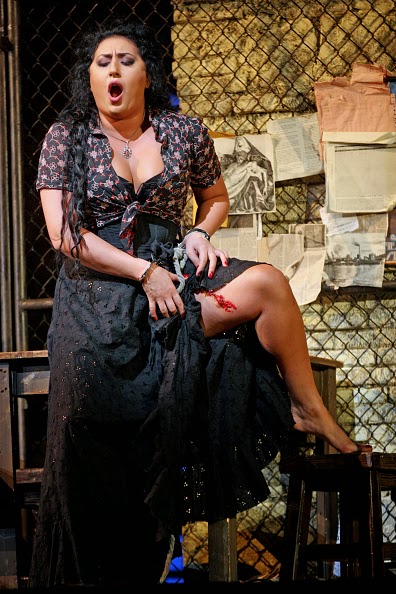
Georgian mezzo Anita Rachvelishvili is a force of nature, a veritable stage animal. Her acting was fierce, aggressive and sensual, as a Carmen should be and maybe even more – the intensity of her passion when initiating intercourse with Don Jose on a table caused a lot of tableware to fall to the ground (which was a realistic yet distracting effect). The rawness of her acting contrasted somehow with her singing, which was surprisingly graceful, and fluid throughout, almost nonchalant, a bit lacking in the guttural, expressive intensity that one would expect from a Carmen. She did achieve peaks of tragic passion in Act IV’s final confrontation with Don Jose, actually sending some shivers down my spine. Rachvelishvili was incredibly mobile on stage and also a great dancer, particularly in Acts II and III, where really embodied the gypsy nature of her character. This singer’s very physical stage presence was evident when we discovered her in Price Igor last year, but she was even more striking in this Bizet role that seems to have become her signature part since her La Scala debut in 2009.


Photo credit: Ken Howard / Met
Soprano Anita Hartig was an impressive Micaela, the loving good girl tending to Don Jose’s sick mother. Her character is Gilda-like and Hartig conveyed it with an angelic purity and innocence while at the same time soaring and effortlessly filling the space more than any of her other colleagues on stage. She left me wanting to hear more from her and I will look forward to seeing her again in a leading role in the future. Bass Ildar Abdrazakov exuded charisma as Escamillo. His entrance in Act II was a showstopper and a pleasure for the eyes and the ears alike. No wonder Carmen dumps that moping Don Jose for this sexy toreador, really a no brainer, especially when Abdrazakov is singing the role! Tenor Aleksandrs Antonenko as Don Jose was passable once he warmed up a bit and as long as he avoided high notes. I am just not crazy about the sound of his voice, particularly in the higher register. Though his sound can be grating on the ears, when he is in the young, naive and in love stage of his early character development, he was easier to palate, especially in the last two acts of the opera when he grows more jaded and angry at the world.

Photo credit: Ken Howard / Met
Frasquita and Mercedes may be minor roles but Kiri Deonarine and Jennifer Johnson Cano did an excellent job in bringing these two gypsies to life with verve and lightheartedness, while at the same time being vocally very strong and displaying great acting skills, they both left me wishing to see more from their characters. The Met’s chorus was as usual excellent, with a special mention for the kids’ section that was particularly delightful and fresh.

Photo credit: Beatriz Schiller
Photo credit: Ken Howard / Met
Rob Howell’s sets were essential and raw, with a circular crumbly stone-like structure serving as backbone for most of the opera, complemented by gates surrounding the square (Act I), Pastia’s bar and dance floor (Act II), mountainous elements (Act III) and the street outside the plaza de toros (Act IV). The simple decadence of the sets made them somehow a-temporal in a very refreshing way. It seems like one of director Richard Eyre’s signature moves is to imbue his overtures with a little does of stage action (think of this year’s Nozze). Here he chose to have each act’s overture/prelude punctuated by a couple of dancers performing the different stages of Carmen and Don Jose’s love story, which was a nice touch, particularly with red lighting that emphasized the violence and passion flowing through the opera. The direction was all in all pretty straightforward, with some particularly effective ideas in Act IV. The parallel between Carmen as a force of nature who needs taming and the bull whom matador arrives in the parade to strike down is really pounded into the audience full force in this production:

C’est l’Espada, la fine lame,
celui qui vient terminer tout,
qui paraît à la fin du drame
et qui frappe le dernier coup!


As Escamillo enters in full regalia on his way to the bullring, the chorus sings a metatextual reflection of what happens in the final seconds of the drama. And the last image Eyre leaves us with is a split-frame glimpse of the corpse of Carmen on one side of the stage and her virtual mirror image in the cadaver of the bull that is revealed once the circular stage spins open and the bullring after the bullfight is brought into view. Like the sacrificial bull, Carmen has been laid low, her carefree toying with men’s emotions has back to haunt her. And the story spins full circle.

- Lei & Lui
Photo credit: Ken Howard / Met
Photo credit: Met  
Photo credit: Ken Howard / Met
Photo credit: Met