Showing posts with label Nozze. Show all posts

Saturday, February 25, 2017

Glittery Saturated Baroque at Juilliard

Handel’s Agrippina
Juilliard School of Music
February 16, 2017
  
A sickly Claudius who just keeps refusing to die
Photo credit: Richard Termine
I never pass up an opportunity to catch some staged fiery baroque opera. Agrippina, Handel’s semi-serious farce on the slow setting of the sun on the emperor Claudius’s reign, is one of those oddities that you just never know what to do with. It presents a slew of emotionally gripping serious musical moments which are then juxtaposed to many of the classic opera buffa tropes, some of which will make their way into Beaumarchais’ Figaro trilogy and from there into Mozart and Da Ponte’s Nozze di Figaro.

Whereas Agrippina reigns supreme
Photo credit: Hiroyuki Ito
Yet, Juilliard’s production of Agrippina was a beautifully crafted and richly detailed little package delivered with explosive flair. Which should come as no surprise since the show was directed by Heartbeat Opera’s Louisa Proske, who has been rapidly building a solid track record of detail-oriented, thoughtful and irreverent productions. The opera was staged in the Wilson Theater, one of the small black box venues buried deep in the labyrinthine studio space of the Juilliard School. The audience sat around a small sunken set covered in overlapping red-hued oriental rugs and the orchestra played from a platform above the rear of the “stage.” This setting provided a highly intimate experience with excellent acoustics, where the few lucky spectators could really focus on the action and the several show-stopping arias that are really the best part of this opera.

The whole cast was impressive for being so young in terms of their ability to nail this virtuosic baroque material with almost flawless Italian diction. They all handled the highly melismatic coloratura of the score with poise and skill and none of them were breathless in their pursuit of the period orchestra under the direction of Jeffrey Grossman, which sounded great yet not as muscular as my favorite renditions of Handel’s score.

Poppea (left) despairs before the Empress Agrippina
Photo credit: Hiroyuki Ito
Particularly impressive highlights were soprano Samantha Hankey (as Agrippina) and the countertenor Jakub Jozef Orlinski (as Ottone). Ms. Hankey reigned over the entire production grounding it in some semblance of seriousness. She embodied a fiercely scheming, power-hungry woman who is unstoppable in her aspiration of situating her son Nerone on the throne. Vocally, she was impressive, particularly in Pensieri, voi mi tormentate. Mr. Orlinski was particularly expressive and beautifully musical, all while displaying a kinetic stage presence. At one point he literally did three back flips consecutively in place that emphasized his exuberant joy when he realizes Poppea does return his love. I guess that when you have a breakdancing countertenor on hand, you have make the most of it.

Roman regalia meets baroque pomp meets steampunk strange
Photo credit: Hiroyuki Ito
The cast sported mostly awe-inspiring, eccentric costumes, sort of a cross between ancient Roman regalia and high baroque swank, with some extra glitter for good measure. Goth and steampunk elements were also slipped in under the radar adding an odd note to the mix. Also, while I get the importance of the many sexual tensions peppered through the plot, perhaps a giant hand-shaped sex toy used by Poppea’s suitors to express their arousal was probably a tad too much. On the other hand, Nerone crawling constantly out from behind his mother between her legs made more sense as it was semi-sexual but also emphasized his forever childishness which worked with plot and character.

All hail the Caesar!
Photo credit: Voce di Meche
And so yes, Handel’s Agrippina is a farce masquerading as semi-serious opera. With its tidy conclusion, it is a comedy of sorts. Some have even called it an antiheroic satirical comedy for its reported commentary on court intrigues of the time, most of which is lost on us now, as is the goofy way that certain moments of operas like this one inevitably play out. While so much of the music is so visceral, so grave and so serious, many story elements and several plot points don’t really rise to the gravitas of the occasion to match.

Agrippina (right) deploys her powers
Photo credit: Hiroyuki Ito
The story hinges on a series of lies, with intersecting plots carried out secretly. Everybody is tricking everybody else at one point. Much like the count in Le nozze di Figaro, the emperor Claudius has designs to cheat on his wife Agrippina with the loveliest lady-in-waiting, Poppea, who is in turn desired by both Ottone and Nerone. In order to get the emperor to regain his focus, Poppea, Agrippina and just about everybody else all choreograph their own overlapping plots and schemes to achieve their various desired outcomes. The shakedown and its accompanying recognition scene only come late and it culminates in a happy ending with divine reconciliation piled on heavy.

All is well that ends well, except for the fact that Louisa Proske and her team decided to saturate the scene with a quick final flash of blood red light once Nerone grabs the scepter of power in the end, foreboding of what’s to come under the emperor’s dangerously childish rule. And perhaps that was the moment where the political satire made itself felt for audiences today – an extra flourish added by the production team that portends terrible things when the emperor is little more than a man-child.

– Lei & Lui

Court intrigue is the order of the day
Photo credit: Hiroyuki Ito

Saturday, December 5, 2015

William Kentridge Takes New York

William Kentridge’s Refuse the Hour
Brooklyn Academy of Music (BAM)
October 23, 2015

Alban Berg’s Lulu
Metropolitan Opera
November 14, 2015

The professor is in. William Kentridge holds forth in Refuse the Hour
Photo Credit: BAM
William Kentridge is not only a monster of energy; he is an inexhaustible fount of ideas. Refuse the Hour, his experimental opera for spoken voice that was featured in this year’s Next Wave Festival at BAM, is so bursting with ideas that it was almost difficult to keep up with its highly conceptual barrage of visual inventiveness and playful intelligence. The dynamic production starred the artist himself reading a text that at times waxed poetic, at others told a story, other times preached, others still lectured, and featured dancers, singers, actors, mimes, an unconventionally orchestrated live band as well as a number of other Duchamp-inspired contraptions, including an automaton mechanized percussion section that dangled decoratively from the ceiling. Not to mention the ever-changing projections that were full of familiar Kentridge touches. 

Language and its vicissitudes take center stage.
Photo Credit: BAM
Onto three proscenium-sized screens were projected a visual collage of video, drawings, charcoal sketches and animations. The projections employed his signature charcoal sketches and animations predominantly drawn onto pages from a dictionary. And here the dictionary trope was very tightly thematically linked to the work as a whole. Many of the vignettes were about language. One particularly memorable vignette dramatized the concept of entropy through the enact of speech acts falling apart, disintegrating over time and then slowly recomposing themselves through the thought experiment of reversing time.

Lulu living in a supersaturated world.
Photo Credit: Ken Howard / Met
Kentridge does something similar in his production of Alban Berg’s Lulu, which debuted at the Metropolitan Opera this fall. Dressing her in a boxy canvas-white smock, she is quite literally a canvas onto which the men around her can project their desires for a good portion of the show. Like the words in the dictionary pages or in the entropy vignette in Refuse the Hour, her beauty is deconstructed, broken down into its constituent parts, quite literally represented by abstractions of her body parts. Only this time rather than playing exclusively with language, Kentridge takes up the challenging musical landscape that Lulu inhabits and seems to in part recast elements of her feminine charms into the symbols of musical notation. For example, the breast that she wears pinned onto his canvas-like smock like a tail pinned onto a donkey at a child’s birthday party is quite simply an inverted fermata sign borrowed from the musical lexicon.

Lulu deconstructed.
Photo credit: Ken Howard
And of course, Berg’s score is notoriously challenging, for the orchestra and singers as well as for the audience. There is nothing straightforward about the singspiel-esque vibe of the whole piece. Unlike Wozzeck, which eschews the limitations of his mentor Schoenberg’s twelve-tone compositional technique, Lulu is Berg’s great dodecaphonic masterpiece. The development of each of its characters as well as the sequence in which they appear and disappear in the score is all determined by charts organized around a predetermined sequence of twelve tones. Where Berg deconstructs his characters musically, Kentridge deconstructs them visually though the signs and symbols of the music, at least in certain details, like the abstraction of his heroine’s body parts.

Lulu's charms are irresistible.
Photo credit: Ken Howard
After seeing her in other video recordings of the opera, Marlis Petersen is on the top of her game as Lulu. In fact, I can hardly picture her being played by any of the other world class sopranos that I know. Petersen just has all the right moves. Her stage presence is magnetic, she embodies the innate Germanness of the character, she is playful, youthful, sexy, strong and yet vulnerable, out of control and riding the wave, controlling and yet acting impetuously, nonchalant and uncaring yet needy, desperate for affirmation, attention, affection, appreciation. However, I also can't help but thinking at almost every minute she is on stage that her talent isn't being somehow also at the same time wasted. She sang such a transcendent Susanna in last year’s gala production of Le nozze di Figaro that it seems like a shame not to have her embodying musically richer tapestries of sounds rather than all this cacophony.

Like a blank canvas, she's everything you want her to be.
Photo credit: Metropolitan Opera
Who is this Lulu? She is a broken girl. Only on the verge of womanhood. She is an object of desire. She is a blank canvas onto which men of all ages, walks of life, shapes, and sizes project their fantasies. She is a commodity. At one point, she is even traded like a stock on the stock market. Shares of an entity or publicly traded company called Jungenfrau (literally Youngwoman in English) are booming in the beginning of Act III, though the Kentridge production never plays it up the way other productions do. (Since she isn’t even on stage during the buying and selling of this hot property, the link between the shares and the physical person of Lulu is only left abstract.) She is a seductress and a murderess and a lover and a muse and an infatuation and a sex kitten. But is she really a femme fatale? Not particularly. When she finds herself making fatal decisions she hardly does so maliciously of her own volition.

Dr. Schön gets worked up.
Photo credit: Ken Howard
Everything falls apart for her after she loses/murders the only man whom she really loves. Does that make it some kind of cautionary tale? Violence is not the solution. Like everything else she does she seems to pull the trigger even innocently. Not aware of the consequences of such a decisive decision. The same seems to happen with the way she toys with all the men in her life. Sex is virtually meaningless to her. But she thrives on all the attention and affection she gets from them, as though she is still an unformed person, not sure of herself, incapable of loving herself first. Towards the end Schilogen says that she is trying to make a living through love, but love is her life. Just minutes later, however, we see her desperately groping for sustained attention from a father looking or at least a man old enough to be her father. "Will you come back to see me again," she says in desperation. Without Dr. Schön she is truly missing the only father figure, lover, partner, spouse she ever really had. He was her everything. There was hardly a role he didn’t play for her. Since she never had anyone else to fill those roles, without him she is truly an empty vessel – the famous blank canvas onto which men project their desires freely. Lulu herself also demands to be painted on and projected upon. She can be anything they want because she is nothing without their desires.

An assassin is born.
Photo credit: Ken Howard
At the same time however Lulu is equally incapable of returning the affection of those who really do love her. The rejected lesbian countess then ponders suicide. She is in the throes of the disease she contracted on Lulu’s behalf and is hurt that Lulu won't ever love her back. “Her heart is cold as ice,” she says but in a hopeful turn abandons the plan to take her own life and instead resolves to make one last attempt, one last plea at her heart.

Lulu with her precious portraits.
Photo credit: Ken Howard 
In a stroke of signature Kentridge genius, after Jack the Ripper stabs both Lulu and the Countess he frantically searches for a rag to wipe the blood off his blade. When he finds nothing better, he picks up one of Lulu’s portraits and wipes her blood off on it like nothing more than a mere rag. This is the fate of all commodities in this consumerist world. Art like stocks like all human capital can be worth millions one moment, reduced to scrap paper the next.

And so perhaps it's a parable about the commodification of art in the first half of the twentieth century – an opera about commodification of women who is a musical abstraction in her own right, set to the music of atonality, which was conceived as a reaction to the traditional bourgeois commodification of music. Remember the opera opens with a circus master hawking admission to his spectacle starring a woman whom he has configured as the most horrific of serpents, a sight you just can't take your eyes off, a veritable box of Pandora.

Sad but true and Lulu amounts to little more than this: a beautiful flash in the pan, a scrap of paper to be taken up and then discarded.

And the world rages on.

– Lui & Lei


Tuesday, November 18, 2014

The Taming of the Gypsy

Bizet’s Carmen
Met Opera
October 28, 2014
Photo credit: Ken Howard / Met
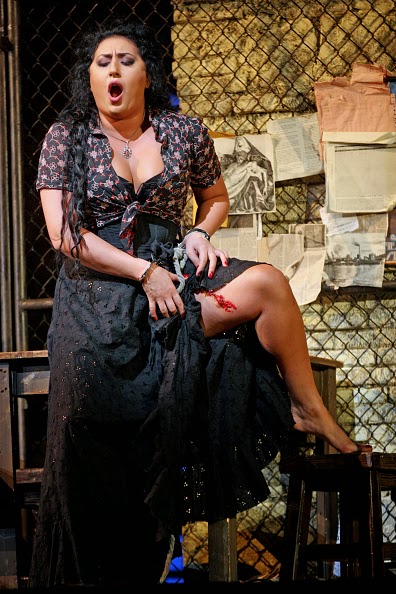
Tonight revisiting Carmen, I was reminded why it’s such a blockbuster. With nine hundred and ninety two performances at the Met alone, Georges Bizet’s 1875 opera is immensely and effortlessly entertaining. It features wonderful music at every turn with a variety of different themes and Spanish-tinged melodies that are always fiery and pleasant to the ear. In terms of the plot, which is linear and very easy to follow, this is not an opera of nuance – dutiful, good-boy soldier falls for beautiful, free-spirited gypsy, who (maybe) loves him back (for a bit), drags him into an adventurous life of danger as an outlaw smuggler; soldier is not really made for this, but is crazy about his gypsy, while torn by remorse for not being close to his loving mother and not behaving like a good citizen; enter hot, free-spirited torero who whisks the beautiful gypsy away; soldier goes crazy with jealousy and stabs gypsy to death.

Photo credit: Met 
Although the story may be simple, the music is complex and multi-faceted and brings different themes alive with immediacy, power and expressiveness. Often times Bizet’s score switches the musical mood several times within a single scene to emphasize the various strands that are all going on at once so that in the span of only a few minutes the tone will change from celebratory to dangerous to loving, and then back to festive, really illustrating how the unity of the plot consists of a multiplicity of ideas that all work together beautifully.

Photo credit: Met
Young, passionate and energetic, Pablo Heras-Casado is the perfect conductor for Carmen, not the least because of his obvious Spanish sensibility, particularly evident in the opening of Act IV, which musically was one of the highlights of the evening. It is a fiery and breathtaking piece of music that conjures an intensely passionate mood in preparation for the emotional climax to come in the finale. Heras-Casado kept the whole opera moving at a brisk pace, distilling every nuance of the wonderful Bizet score. He really brought it to life for me like never before and made me realize that the music may actually be the true, and certainly the most complex, protagonist here.

Photo credit: Hioryuki Ito / NYT
Georgian mezzo Anita Rachvelishvili is a force of nature, a veritable stage animal. Her acting was fierce, aggressive and sensual, as a Carmen should be and maybe even more – the intensity of her passion when initiating intercourse with Don Jose on a table caused a lot of tableware to fall to the ground (which was a realistic yet distracting effect). The rawness of her acting contrasted somehow with her singing, which was surprisingly graceful, and fluid throughout, almost nonchalant, a bit lacking in the guttural, expressive intensity that one would expect from a Carmen. She did achieve peaks of tragic passion in Act IV’s final confrontation with Don Jose, actually sending some shivers down my spine. Rachvelishvili was incredibly mobile on stage and also a great dancer, particularly in Acts II and III, where really embodied the gypsy nature of her character. This singer’s very physical stage presence was evident when we discovered her in Price Igor last year, but she was even more striking in this Bizet role that seems to have become her signature part since her La Scala debut in 2009.


Photo credit: Ken Howard / Met
Soprano Anita Hartig was an impressive Micaela, the loving good girl tending to Don Jose’s sick mother. Her character is Gilda-like and Hartig conveyed it with an angelic purity and innocence while at the same time soaring and effortlessly filling the space more than any of her other colleagues on stage. She left me wanting to hear more from her and I will look forward to seeing her again in a leading role in the future. Bass Ildar Abdrazakov exuded charisma as Escamillo. His entrance in Act II was a showstopper and a pleasure for the eyes and the ears alike. No wonder Carmen dumps that moping Don Jose for this sexy toreador, really a no brainer, especially when Abdrazakov is singing the role! Tenor Aleksandrs Antonenko as Don Jose was passable once he warmed up a bit and as long as he avoided high notes. I am just not crazy about the sound of his voice, particularly in the higher register. Though his sound can be grating on the ears, when he is in the young, naive and in love stage of his early character development, he was easier to palate, especially in the last two acts of the opera when he grows more jaded and angry at the world.

Photo credit: Ken Howard / Met
Frasquita and Mercedes may be minor roles but Kiri Deonarine and Jennifer Johnson Cano did an excellent job in bringing these two gypsies to life with verve and lightheartedness, while at the same time being vocally very strong and displaying great acting skills, they both left me wishing to see more from their characters. The Met’s chorus was as usual excellent, with a special mention for the kids’ section that was particularly delightful and fresh.

Photo credit: Beatriz Schiller
Photo credit: Ken Howard / Met
Rob Howell’s sets were essential and raw, with a circular crumbly stone-like structure serving as backbone for most of the opera, complemented by gates surrounding the square (Act I), Pastia’s bar and dance floor (Act II), mountainous elements (Act III) and the street outside the plaza de toros (Act IV). The simple decadence of the sets made them somehow a-temporal in a very refreshing way. It seems like one of director Richard Eyre’s signature moves is to imbue his overtures with a little does of stage action (think of this year’s Nozze). Here he chose to have each act’s overture/prelude punctuated by a couple of dancers performing the different stages of Carmen and Don Jose’s love story, which was a nice touch, particularly with red lighting that emphasized the violence and passion flowing through the opera. The direction was all in all pretty straightforward, with some particularly effective ideas in Act IV. The parallel between Carmen as a force of nature who needs taming and the bull whom matador arrives in the parade to strike down is really pounded into the audience full force in this production:

C’est l’Espada, la fine lame,
celui qui vient terminer tout,
qui paraît à la fin du drame
et qui frappe le dernier coup!


As Escamillo enters in full regalia on his way to the bullring, the chorus sings a metatextual reflection of what happens in the final seconds of the drama. And the last image Eyre leaves us with is a split-frame glimpse of the corpse of Carmen on one side of the stage and her virtual mirror image in the cadaver of the bull that is revealed once the circular stage spins open and the bullring after the bullfight is brought into view. Like the sacrificial bull, Carmen has been laid low, her carefree toying with men’s emotions has back to haunt her. And the story spins full circle.

- Lei & Lui
Photo credit: Ken Howard / Met
Photo credit: Met  
Photo credit: Ken Howard / Met
Photo credit: Met