Showing posts with label Heras-Casado. Show all posts

Tuesday, November 18, 2014

The Taming of the Gypsy

Bizet’s Carmen
Met Opera
October 28, 2014
Photo credit: Ken Howard / Met
Tonight revisiting Carmen, I was reminded why it’s such a blockbuster. With nine hundred and ninety two performances at the Met alone, Georges Bizet’s 1875 opera is immensely and effortlessly entertaining. It features wonderful music at every turn with a variety of different themes and Spanish-tinged melodies that are always fiery and pleasant to the ear. In terms of the plot, which is linear and very easy to follow, this is not an opera of nuance – dutiful, good-boy soldier falls for beautiful, free-spirited gypsy, who (maybe) loves him back (for a bit), drags him into an adventurous life of danger as an outlaw smuggler; soldier is not really made for this, but is crazy about his gypsy, while torn by remorse for not being close to his loving mother and not behaving like a good citizen; enter hot, free-spirited torero who whisks the beautiful gypsy away; soldier goes crazy with jealousy and stabs gypsy to death.

Photo credit: Met 
Although the story may be simple, the music is complex and multi-faceted and brings different themes alive with immediacy, power and expressiveness. Often times Bizet’s score switches the musical mood several times within a single scene to emphasize the various strands that are all going on at once so that in the span of only a few minutes the tone will change from celebratory to dangerous to loving, and then back to festive, really illustrating how the unity of the plot consists of a multiplicity of ideas that all work together beautifully.

Photo credit: Met
Young, passionate and energetic, Pablo Heras-Casado is the perfect conductor for Carmen, not the least because of his obvious Spanish sensibility, particularly evident in the opening of Act IV, which musically was one of the highlights of the evening. It is a fiery and breathtaking piece of music that conjures an intensely passionate mood in preparation for the emotional climax to come in the finale. Heras-Casado kept the whole opera moving at a brisk pace, distilling every nuance of the wonderful Bizet score. He really brought it to life for me like never before and made me realize that the music may actually be the true, and certainly the most complex, protagonist here.
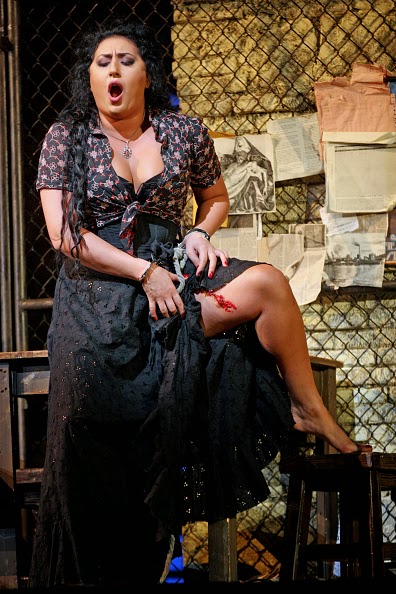
Photo credit: Hioryuki Ito / NYT
Georgian mezzo Anita Rachvelishvili is a force of nature, a veritable stage animal. Her acting was fierce, aggressive and sensual, as a Carmen should be and maybe even more – the intensity of her passion when initiating intercourse with Don Jose on a table caused a lot of tableware to fall to the ground (which was a realistic yet distracting effect). The rawness of her acting contrasted somehow with her singing, which was surprisingly graceful, and fluid throughout, almost nonchalant, a bit lacking in the guttural, expressive intensity that one would expect from a Carmen. She did achieve peaks of tragic passion in Act IV’s final confrontation with Don Jose, actually sending some shivers down my spine. Rachvelishvili was incredibly mobile on stage and also a great dancer, particularly in Acts II and III, where really embodied the gypsy nature of her character. This singer’s very physical stage presence was evident when we discovered her in Price Igor last year, but she was even more striking in this Bizet role that seems to have become her signature part since her La Scala debut in 2009.


Photo credit: Ken Howard / Met
Soprano Anita Hartig was an impressive Micaela, the loving good girl tending to Don Jose’s sick mother. Her character is Gilda-like and Hartig conveyed it with an angelic purity and innocence while at the same time soaring and effortlessly filling the space more than any of her other colleagues on stage. She left me wanting to hear more from her and I will look forward to seeing her again in a leading role in the future. Bass Ildar Abdrazakov exuded charisma as Escamillo. His entrance in Act II was a showstopper and a pleasure for the eyes and the ears alike. No wonder Carmen dumps that moping Don Jose for this sexy toreador, really a no brainer, especially when Abdrazakov is singing the role! Tenor Aleksandrs Antonenko as Don Jose was passable once he warmed up a bit and as long as he avoided high notes. I am just not crazy about the sound of his voice, particularly in the higher register. Though his sound can be grating on the ears, when he is in the young, naive and in love stage of his early character development, he was easier to palate, especially in the last two acts of the opera when he grows more jaded and angry at the world.

Photo credit: Ken Howard / Met
Frasquita and Mercedes may be minor roles but Kiri Deonarine and Jennifer Johnson Cano did an excellent job in bringing these two gypsies to life with verve and lightheartedness, while at the same time being vocally very strong and displaying great acting skills, they both left me wishing to see more from their characters. The Met’s chorus was as usual excellent, with a special mention for the kids’ section that was particularly delightful and fresh.

Photo credit: Beatriz Schiller
Photo credit: Ken Howard / Met
Rob Howell’s sets were essential and raw, with a circular crumbly stone-like structure serving as backbone for most of the opera, complemented by gates surrounding the square (Act I), Pastia’s bar and dance floor (Act II), mountainous elements (Act III) and the street outside the plaza de toros (Act IV). The simple decadence of the sets made them somehow a-temporal in a very refreshing way. It seems like one of director Richard Eyre’s signature moves is to imbue his overtures with a little does of stage action (think of this year’s Nozze). Here he chose to have each act’s overture/prelude punctuated by a couple of dancers performing the different stages of Carmen and Don Jose’s love story, which was a nice touch, particularly with red lighting that emphasized the violence and passion flowing through the opera. The direction was all in all pretty straightforward, with some particularly effective ideas in Act IV. The parallel between Carmen as a force of nature who needs taming and the bull whom matador arrives in the parade to strike down is really pounded into the audience full force in this production:

C’est l’Espada, la fine lame,
celui qui vient terminer tout,
qui paraît à la fin du drame
et qui frappe le dernier coup!


As Escamillo enters in full regalia on his way to the bullring, the chorus sings a metatextual reflection of what happens in the final seconds of the drama. And the last image Eyre leaves us with is a split-frame glimpse of the corpse of Carmen on one side of the stage and her virtual mirror image in the cadaver of the bull that is revealed once the circular stage spins open and the bullring after the bullfight is brought into view. Like the sacrificial bull, Carmen has been laid low, her carefree toying with men’s emotions has back to haunt her. And the story spins full circle.

- Lei & Lui
Photo credit: Ken Howard / Met
Photo credit: Met  
Photo credit: Ken Howard / Met
Photo credit: Met 


Thursday, December 19, 2013

You're Irresistible, Baby!

The Met’s Las Vegas Rigoletto
November 30, 2013

Photo credit: Ken Howard / Met Opera
We're in Las Vegas, circa 1960. “The Duke” is a Sinatra-like singer and the powerful owner of a casino where vice, money and decadent entertainment abound. He’s also a serial womanizer who can never get enough of the ladies. In fact, his entourage of suave men in shiny tuxedos often procures fresh prey for him. The hunchback Rigoletto is a comic who works for the Duke and is always poking fun at everyone, often pushing jokes too far. Enter a wealthy Arab sheik that Rigoletto needles obscenely as a cover to the Duke's recent conquest of his daughter. The humiliated sheik explodes in a rage and curses both the Duke and his comic. In a city where luck and superstition rule, a “maledizione” is serious stuff.

Photo credit: Ken Howard / Met Opera
Rigoletto gets off his comic shift and goes home to his only family, his beloved daughter Gilda – a beautiful pious young thing he keeps locked up at home at all times (except to go to Sunday mass). He is too afraid the vicious men of the town may corrupt his good little girl. Bad luck has it that somehow the Duke managed to lay eyes on sweet, chaste Gilda and decides he wants her. This time his trick will be to play the part of a lovey-dovey penniless student, which works pretty well. Gilda falls romantically head over heels for the “student” who also seems totally taken though that, too, could just be another womanizing strategy.

The Duke’s entourage decides to play a prank on Rigoletto and, thinking that Gilda is his lover, they abduct her and bring her to the Duke for his entertainment. The Duke deflowers Gilda at lightening speed and immediately thereafter loses interest. When Rigoletto discovers what happened to his innocent daughter he is rage-crazed and swears to avenge her honor. His bloody vengeance involves a hired (but honest) assassin and his slutty sister and it may or not go as planned...

Photo credit: Ken Howard / Met Opera
Does this sound like an 1851 opera? Or more like a modern mob movie? The Met showed us that time and place hardly matter as this story could be set in 16th century Mantua or 1960s Las Vegas and work equally well. Either way, it’s rife with dramatic tension, fiercely passionate Verdi music and some of the most beautiful singing.

It was a thrill to see the Met’s 2012 Las Vegas Rigoletto again. The singers in last year’s inaugural cast for the debut of this new production were so spectacular that it hardly mattered where they set it. Revisiting it again this year with a new cast and Pablo Heras-Casado conducting, we stand by the conviction that this modernized production works. The sets are dynamic and elaborate and the story is only made more vivid than if they had kept it in sixteenth-century Mantua with men in tights and puffy sleeves.

This time we decided to follow the Met English subtitles throughout the opera. And not out of necessity (being Italian speakers and knowing Rigoletto by heart) but rather because we heard that subtitles, too, were innovated by this production. The Met pushed its modernizing efforts to the point of revising the traditional English translation of the Italian libretto to jazz it up with 1960s Vegas slang. Updating the subtitles to match the era in which the opera is set is sure blasphemy to purists and really a double-edged sword. On the one hand, it can engage the non-Italian speaking audience in livelier ways than a verbatim translation of 19th-century poetic language, which is admirable. On the other hand, however, it may be distracting and fall into the trap of going too far and radically changing the sense of the original, which is, indeed, a mortal sin even by our standards.

The Met did not fall into such trap and offered a refreshingly updated and often clever translation by Michael Panayos and Paul Cremo, without ever departing from the original core meaning but rather just massaging the text with glittery period touches that most times worked pretty well. Here’s an example:
Photo credit: Ken Howard / Met Opera

Original Libretto:

DUCA
Ma dee luminoso
In corte tal astro qual sole brillare.
Per voi qui ciascuno dovrà palpitare.
Per voi già possente la fiamma d'amore
Inebria, conquide, distrugge il mio core.
CONTESSA
Calmatevi …

Traditional Translation:

DUKE
So bright a star should be shedding
Photo credit: Ken Howard / Met Opera
its brilliance on my court.
You would make every heart beat faster here.
The fires of passion already flare
headily, conquering, consuming my heart.
COUNTESS
Calm yourself!

“Rat Pack” Translation:

DUKE
Your movie-star looks
really light up the place
Photo credit: Ken Howard / Met Opera
Every heart in this club
should be beating for you
You’re irresistible, baby
you make me burn with love
you send me to the moon!
COUNTESS
Take it easy, fella!


The “astro,” or star, metaphor carries over into a reference to movie starlets, and the Duke’s court is appropriately reconfigured as a club, while the Petrarchan language of the consuming fires of love translate directly into hepcat talk. It’s colorful and clever and almost even more successfully poetic with respect to the otherwise rather bland conventional English translation also presented here. After all, the Duke’s character is the kind of superficial lady’s man who would have come up with zingers like: “Come on, baby, let’s give it a whirl!


When it comes to narrative strategies, Michael Mayer’s production not only remains true to the core of the original opera but also adds several touches that flesh out better the characters. The Duke’s is one of the characterizations that benefited most from the Vegas take. In classic productions, when in Act II he is sad because he thinks Gilda has been kidnapped and he starts going all mushy about she being “the one,” it is always a bit hard to believe since the Duke is supposed to be a chauvinist womanizer. This production has him do lines of cocaine and drink hard liquor while he sings these arias, thus suggesting, in line with the core of the character, that the Duke was just babbling under the effects of hard drugs and stiff alcohol, and, no matter how convinced he sounds in his singing, his convictions are as steadfast as a feather in the wind. Later, in Act III this Sinatra-like Duke sings the famous misogynistic aria “La donna e’ mobile / qual piuma al vento” while twirling around the pole of a strip club, making it clear (in case there was any doubt) that he’s the fickle one, not women.


Photo credit: Ken Howard / Met Opera

Another stroke of genius is the Rat Pack transformation of the Duke’s entourage that perfectly reflects the goliardic spirit of the courtiers, and very entertainingly so. Their chorus scenes are extremely vivid and effective, with a group of men in shiny multi-color tuxedos and a lot of hair gel gallivanting around in grand early-1960s cinematic style, all while singing Verdi. The three main Rat Pack characters, Borsa (Alexander Lewis), Marullo (Jeff Mattsey) and Count Ceprano (David Crawford) were definitely more fleshed out here than in other productions. Inspired by the likes of Sammy Davis, Jr., Dean Martin and Sam Giancana, they evidently had a lot of fun with their roles and they were a pleasure to watch with their shenanigans, especially during some of the musical interludes.

This production at times even improves the narrative when compared to a more traditional setting. In fact, in Act II classic productions always struggle with a weak plot point when Rigoletto cannot hear the courtiers kidnapping his screaming daughter while he holds a ladder because he has a mask over his eyes (that allegedly also covers his ears?!?). Mayer cleverly solves the problem by sending Rigoletto “upstairs” in an elevator so that he’s not physically there when the actual kidnapping occurs and his failure to notice is thus made credible.

Photo credit: Ken Howard / Met Opera
Željko Lučić was just so spectacular last year that it was going to be a tall order for Dmitri Horostovsky to match his predecessor’s performance in the eponymous role. With his action movie star good looks, Dmitri is not your typical Rigoletto. And boy did they do a number on him in make-up! His transformation from “barihunk” into old hunchback with paunch and a few strands of white hair combed across an almost bald scalp was terrific, particularly since the proud shaking of his flowing silver mane is one of Dmitri's signature moves in virtually every other role he performs. Also, one would think that both his haughty acting and fierce singing style generally better suit a sexy villain rather than the hunch-backed, pathos-invoking paterfamilias at the center of Verdi’s Rigoletto.


Photo credit: Ruby Washington / The New York Times
Dmitri’s acting was intensely accurate and generally successful in getting into character, showing a range that we rarely see from him. In the first scene he was hamming it up with the lounge dancers and twisting his hips like Elvis as he taunted the sheik, rendering the comic side of Rigoletto very energetic when compared to traditional settings. Horostovsky was a fairly convincing tender father in his duets with Gilda, however his best stage presence (not surprisingly) was in the raging bits, so much that in “Cortigiani, vil razza dannata,” he was a bit too busy forcefully acting and running from one courtier to the other, affecting a bit the intensity of his singing. While Dmitri’s angry-edged baritone sounded on the snarling end at times, he consistently delivered deep dark tones with hints of a smooth sweetness that made for a vocally charismatic Rigoletto. The evening we saw him, his voice felt unusually restrained in the first act, but when he loosened up he was sensational. His duets with Gilda were as lovely and heart wrenching as ever, “Fanciulla piangi” making the fanciulla of us cry copiously and Dmitri’s vocal performance in the third act ranged from vengeful to deeply dramatic to desperately defeated, just the way we like a Rigoletto.


Photo credit: Ken Howard / Met Opera
But it was the young soprano, Sonya Yoncheva, who stole the show while stepping in to replace Aleksandra Kurzak (pregnant with tenor Roberto Alagna’s child). Yoncheva sang consistently stronger than anybody else on stage, outshining even all of the seasoned Met veterans in this cast, including both Horostovsky and Polenzani. The piercing purity of her voice streamed effortlessly from her petite frame. With her frail yet powerful lyricism and her charming presence, Yoncheva dominated her scenes gracefully and tragically. Fresh faced and youthful, she really looked the part and embodied all the vulnerability of the poor tragic naïve Gilda. Yoncheva did not win Placido Domingo’s Operalia competition in 2010 for nothing – definitely a singer to keep an eye on.

Matthew Polenzani is growing on us, while we were not convinced by his Nemorino in 2012, we enjoyed him in Maria Stuarda and Così and really appreciated him as the Duke. He delivered clean, fresh sound, clear articulation, on point tempo and musicality, and great Sinatra-like acting. On the whole, he is highly likeable, but he still does not stir the deep turmoil that a world-class Italian-style tenor should be capable of. We find Polenzani to be often too high pitched; lacking a certain manly depth, with his voice still sounding almost too young, remaining too firmly on the surface.  

Photo credit: Ken Howard / Met Opera
Slovak bass Stefan Kocán always exudes charisma with commanding stage presence and his Sparafucile was no exception. While we've seen and loved him before in the role, this time his acting got even better, portraying the honest villain (he may be a hired assassin but he's not a thief!) with the sleek confidence of a film noir actor. Vocally, Kocán has a deep, rich and smooth tone that somehow comes as a surprise from such a young singer and is always a pleasure to hear. We wish there were more extensive bass roles around so that we could get more Kocán –looking forward to seeing him as Konchak in Prince Igor in February!

A lot has been said about the spectacular sets of this production, for which no detail was small enough, from the diverse use of the “neon vocabulary” throughout the three acts, to the wink-wink references to the Met’s own decorative elements (gates, chandeliers, curtains), to the Nevada license plate of Sparafucile’s car ("SPARFUC"). We can only let the pictures speak for themselves and salute the Met’s set design team for the terrific effort.

Photo credit: Ken Howard / Met Opera
This production is to us the perfect example of a clever new take on a classic and thus a must see for virtually everybody: it may entertainingly lure opera-virgins into the art form, convert the traditionalist to modernizations of classic repertoire and refresh Rigoletto for those who know it by heart. Let’s hear it for Met Opera taking more calculated risks like this!

– Lei & Lui