Donizetti’s Elisir d’amore at the Metropolitan Opera
January 17, 2014
 |
Adina (Netrebko) reading the story of Isolde's love elixir
Photo credit: Ken Howard / Metropolitan Opera |
Lui: It is a truth universally acknowledged that all
you need is love. But what does one need in order to procure that love in the
first place? Many of the characters in Donizetti’s deceptively deep Elisir d’amore
put forth assumptions of their own, and over the course of Act I several
hypothetical elixirs are proposed. What is it that makes someone fall for you?
Is it country bumpkin Nemorino’s simple-minded, bull-headed persistence or the
way he shakes his hips in the charming little dance he does? Do words alone do
the trick in the form of desperate pleas? Or are “i soliti sospiri,” the
sighs of a lover’s lusty desire enough? Is it army sergeant Belcore’s
gallantry, his boastfulness, his overweening self-confidence? Or is it
chemical? Is there a drug you can take to procure the desired effect, like
quack doctor Dulcamara’s famous fleeting elixir? “In quel cor non son capace
lieve affetto ad inspirar,”* Nemorino proclaims in his first aria. And so,
in what is truly the show’s opening number, we are presented with the question
pervading the whole opera: What is it that makes us capable of inspiring
that highly sought after “lieve affetto” in the soul of the object of
our affection.
 |
Nemorino (Vargas) sighing over his love
Photo credit: Ken Howard / Metropolitan Opera |
After failing with his usual routine of supplication and
debate, Nemorino changes tack and seeks his expedient for love from the
itinerant confidence man posing as a doctor. While he waits for the “buon Bordeaux” he bought in the guise of
a mythical-medicinal “elixir of love” to kick in, Nemorino starts to
ignore Adina, the woman he desires. And as it turns out, this is what starts to
change the tide in his favor. Once cold to his every affront, Adina slowly
warms up since she suddenly misses the attention he used to lavish on her. By
the end of Act I, it seems that playing hard to get is the best way to prod her
into love. In addition, Adina responds sympathetically to Nemorino as he is brutally pushed around by Belcore in front of the townspeople.
Love may also stem from her compassion for this poor man’s plight.
 |
Mariusz Kwiecień as a playful Belcore in 2012
Photo credit: Metropolitan Opera |
Lei: Adina’s pity for Nemorino was particularly
enhanced in this run of the production, where Belcore was played by Nicola
Alaimo, a very corpulent Italian baritone who portrayed the sergeant’s
arrogance as cruel, abusive and brutal. Quite a difference from when we first
saw this production in the 2012 season opening gala, when this same character
was played by the sexy Polish baritone Mariusz Kwiecień, who interpreted
Belcore’s boastfulness as playfully charming and sardonic, coming off as the
jerk women can’t help but like. When Adina flirts with a Belcore as attractive
and fun as Kwiecień, one can think that she may actually be into him and
perhaps also want to have some fun together, in line with her initial spiel
about free love. On the other hand, if Belcore is of an unappealing Falstaffian
size and demeanor, it is clear that Adina never really falls for him but is
just going along with his advances mostly to appease a threatening invading
soldier. Nicola Alaimo’s singing was very strong and dominating as Belcore,
giving a darker, scarier twist to a character that is often played as simply an
entitled womanizer.
 |
Belcore (Kwiecień) makes Adina (Netrebko) swoon
Photo credit: Sara Krulwich/The New York Times |
 |
Belcore (Alaimo) scares Adina (Chuchman)
Photo credit: Andrea Mohin / The New York Times |
Lui: It was like Falstaff fever had infected this
year’s revival of last year’s new Bartlett Sher production. Belcore was played
with the arrogance and overabundance of a Falstaff still in the prime of his
military life (incidentally, Alaimo did play Falstaff at the Met earlier this
season). It is amazing what a difference casting makes, even just
physiologically.
 |
Nicola Alaimo as a Falstaffian Belcore
Photo credit: Ken Howard / Metropolitan Opera |
Lui: In Act II further remedies for love are put forth:
Does drunkenness turn a lover on? Or is money the true elixir of love? Wealth
seems to be all the rest of the country girls are looking for in a man. As soon
as they find out that Nemorino has suddenly become the recipient of an immense
inheritance upon the death of his uncle, they descend on him like chicken on
corn. But Adina sets the elixir story straight in one of her most beautiful
duets with the itinerant quack, Dulcamara, this time sung powerfully by opera
heartthrob, Erwin Schrott. “La ricetta è il mio visino,” she tells him
when he tries to sell her his famous phony elixir as a solution to her amorous
woes. She knows that her pretty face and feminine wiles are all she needs to
attract her prey. No love-drug, not even a bottle of Bordeaux is necessary for
a woman who knows how to play her charms.
 |
Netrebko's high energy Adina
Photo credit: Metropolitan Opera |
Lei: With explosive acting and singing, Anna Netrebko and
her ex-partner Schrott were on fire. Against all rumors that she may have
called in sick at the opening of this run of Elisir because she did not
want to share the stage with him, Netrebko was in excellent form, maybe the
best I’ve seen her so far. Her acting was really intense and high energy.
Vocally strong, light, fast but also highly lyrical at times. I believe she can
still deliver an outstanding Adina regardless of what some say (that her voice
is now too chesty and mature for this character). Actually, she perfectly
embodies the bossy, power-woman side of Adina. At the end of the day, she owns
and manages a farm so a more womanly portrayal can definitely fit with the
character. She exudes charisma and passion. Always been a fan, after tonight
even more so.
Lui: The chemistry between the two of them was
electric and playful and fun. Even if there was a little tension, they really
played off each other nicely. The dynamic changes when they cast a hot young
hunka hunka burning love like Erwin Schrott to play Dulcamara. It opens up the
possibilities of a series of flirtatious exchanges between he and Adina, which
is exactly what we got. Sparks were flying during their interaction late in Act
II. Their banter was so vivid and lively when the quack doctor is trying to
sell Adina on his magic love potion and she realizes that she has actually
fallen for Nemorino that I found myself caught off guard by the sudden shift to
Nemorino’s big aria as the melancholic refrain of Una furtiva lagrima
kicked in.
 |
A hot Dulcamara (Schrott) and a giggling Adina (Netrebko)
Photo credit: Ken Howard / Metropolitan Opera |
 |
Ambrogio Maestri as a fatherly Dulcamara in 2012
Photo credit: Ken Howard / Metropolitan Opera |
Lei: While I’ve seen Dulcamara done as a young and
sleek con artist (Ildebrando D’Arcangelo in Otto Schenk’s 2005 Vienna
production), this is the first time I’ve seen him portrayed as a Jack Sparrow
type. It worked and was fun, although Schrott’s acting often referenced the
Johnny Depp character a bit too closely, a lighter hand would have probably
worked equally well. Pirate looks aside, I liked Schrott way better than Maestri
who, at least when we saw him last year, acted as a fatherly and condescending
figure without much depth. Dulcamara’s portrayal by this hot Uruguayan
bass-baritone had definitely more sex drive, as he seemed to be groping every
peasant girl who happened to pass by and was very much bewitched by Adina’s “una tenera occhiatina” (though that may
be because his real-life ex was as charming as ever). Schrott was also,
together with Netrebko, the strongest singer on stage, really owning the
Dulcamara character, with perfect Italian, playful crowd-pleasing acting and
effortless vocal power. Yet another excellent baritone who is a pleasure for both the eyes and the ears.
 |
Dulcamara - Jack Sparrow (Schrott)
Photo credit: Ken Howard / Metropolitan Opera |
Lui: Ostensibly set during something like the Italian
Risorgimento with an invading army of foreign soldiers, this new production
takes Nemorino’s simpleton a bit more seriously, casting him as a tormented
soul who is smarter than anyone gives him credit for. During the overture he
paces out in front of the curtain with a little notebook in which he jots down
the poetic thoughts that aggravate his soul (however, he is still too dense to
pick up on the finer points of the Tristan and Isolde story Adina reads to
them). Later the soldiers are surprised to see that he knows how to write his
name, a moment when in most productions he simply signs his life away with an “X,”
which is all that is required of him since they take him for an illiterate
country boy.
 |
Nemorino (Vargas)
Photo credit: Ken Howard / Metropolitan Opera |
Lei: Ramón Vargas’ looks and acting delivered an excellent
Nemorino, sweet, funny and adorable. Definitely more convincing than Polenzani
in this same production back in 2012, who played it almost Hamlet-like,
constantly looking startled by the circumstances around him but without that
lightness and boyish innocence that are quintessential Nemorino character
traits and that Vargas portrayed so well. I wish I could have equally positive
comments on Vargas’ signing but I am sorry to report that he confirmed my
theory that these days there’s a devastating tenor famine. Do they not make
world class Italian-style tenors anymore? Vargas started weak then warmed up
and did a few good things, but delivered a merely passable Una furtiva lagrima that left me lukewarm. While the aria is about
one furtive tear, if it’s done right my tears run copiously and I even sniffle
a bit. All I experienced this time was a touch of extra eye moisture but no
waterfalls whatsoever. So disappointed. Also, the fact that Vargas butchered
quite a few Italian words (for some reason he kept pronouncing double
consonants as singles) did not make him score any extra points
 |
Act I sets
Photo credit: Metropolitan Opera |
It’s funny how seeing the same production a second time can trigger very different reactions. When I first saw Sher’s Elisir in
Spetmber 2012, I got out of the Met ranting and pouting, complaining about its
blandness and unimaginativeness for an opening gala and excessive seriousness
that betrayed the core of Donizetti’s masterpiece. While I stand by the
non-gala worthiness of this setting, after seeing it again, I really enjoyed
this production as traditional yet solid and handsome. One thing though I still
cannot stand: the finale with folks lining up bottles of elixir on the front of
the stage. It just does not work with the libretto and the spirit of Dulcamara’s
final aria. I really think it’s more effective when the quack doctor and his
assistants hand out elixir bottles to the crowd selling them as real love
potions, having everybody buy them and instantly fall in love with their
neighbors, in a love apotheosis with Dulcamara triumphantly exiting as the
savior of the village.
 |
Act II sets
Photo credit: Metropolitan Opera |
Lui: Barlett Sher’s new take replaced a slightly
psychedelic, slightly cartoonish 1991 production that wore its illusions on its
sleeve. Sets were lifted up and down and in and out during the performance so
that the stagecraft was an element of the story itself. Though I was not
convinced by Sher the first time we saw his work at last year’s gala, I have to
admit that it grew on me this time. Having recently revisited the old
production on DVD, this new one is definitely an improvement on the Met’s
precious storybook take on Donizetti’s tightly woven, wrenching (I always cry)
love story disguised as an opera buffa. Though in part I want to credit that to
the thrilling cast we saw in it this year lead by conductor Maurizio Benini. It’s amazing how strong singers
and compelling presences can make all the difference, particularly when stars
like Netrebko and Schrott are in such good form.
Lei: We saw one of the most gossiped opera ex-couples
deliver a terrific joint performance and, yes, kiss enthusiastically (on the
mouth!) at curtain call – perhaps singing about the tricks of love with your ex
at the Met is yet another elisir d’amore to add to our list.
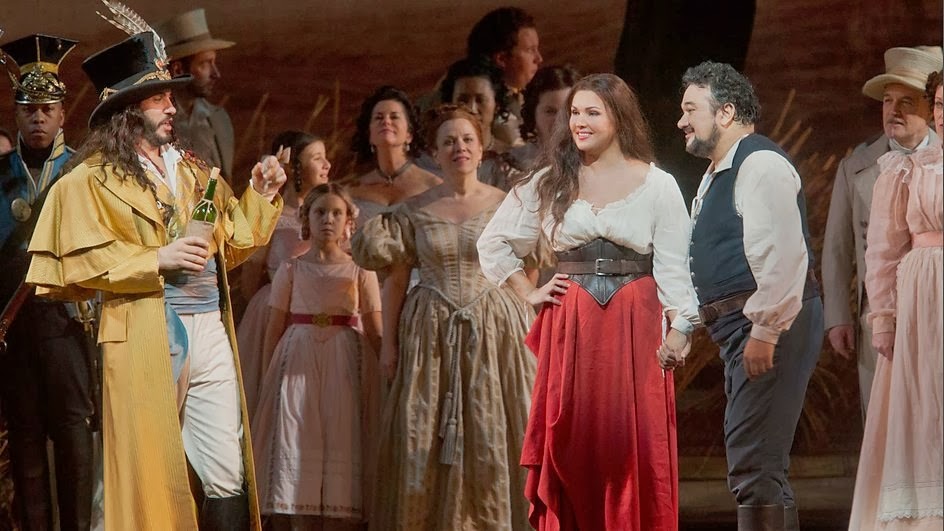 |
Adina (Netrebko) smiling at Dulcamara (Schrott) – off character?
Photo credit: Ken Howard / Metropolitan Opera
|
* “In her heart the slightest affection I am ever unable to
inspire.”


