Showing posts with label Rigoletto. Show all posts

Monday, August 28, 2017

Stuck Between a Count and a Pirate

Bellini’s Il Pirata
Bel Canto at Caramoor
Venetian Theater
July 8, 2017

Imogene and the pirate who washed back into her life
Photo credit: Gabe Palacio
For the twentieth and final year of the celebrated Bel Canto at Caramoor series, Will Crutchfield and his team brought us Bellini’s Il Pirata. The orchestra and extraordinary cast sounded so wonderful that it is a yearly appointment that will be sorely missed. The opera here will continue. Handel’s Atalanta is already on the books for next year we’re told. So the picnics in this bucolic wonderland will continue, but Crutchfield’s intellectually stimulating curatorial efforts will be hard to replace.

Over the years that we have followed his work with the summer festival at Caramoor we have learned a lot about the evolution of Rossini’scompositional style due to his work with a castrato, the influence of Donizetti’s Lucrezia Borgia on Verdi’s Rigoletto and so much more.

The woman who lies at the center of it all
Photo credit: Gabe Palacio
Bellini’s opera may be called Il Pirata but the drama all lies in the heroine. It is the story of her impossible love, which comes down to a matter of principle. In order to save her father from prison, she consented to a loveless marriage with Ernesto, the Count of Caldora. The man she once loved, the eponymous pirate Gualtiero, has been absent for some time.

Until one day he and his pirates wash ashore near her castle in Sicily.

The open and honest emotions of a woman who is sure of herself
Photo credit: Gabe Palacio
What is striking is how forthcoming she is about the whole intersection of circumstances not only with Gualtiero but also with her husband Ernesto. When confronted about her sudden emotional distance from him in Act II, she very frankly says “Yeah, I love him but in the way one might love a dead man.” It’s impossible for her now. Since when did such adult composure of emotion and mind pass for romance? Incredible! “L’amo come uom sepolto,” she says to her husband at this crucial point.

The tragedy is all hers. But that doesn’t mean that Ernesto takes this news like a big boy. Oh no, he gets all fired up in a conniption fit of jealousy and perhaps most surprisingly of all, things don’t end well for him.

Some husbands are more understanding of adult feelings than others
Photo credit: Gabe Palacio
Act II opens strong and moving with this marital confrontation. The singing was exceptional, as we have come to expect from Crutchfield and his crew at Caramoor where four years ago we discovered Donizetti’s gem of an opera Lucrezia Borgia along with star soprano of night, Angela Meade. And what a night it was.

With Lucrezia in mind, I braced myself for a hearty duel between man and wife, a fight to the death. But surprisingly no such face off materialized in this second act opener. They launch into their duet and just when you expect explosive bel canto fireworks, Imogene refrains from going for the jugular (as Lucrezia did) and instead opts for adult frankness. Unbelievable! She embodies all the values of maturity, honesty, sincerity. The opera should bear her name rather than the poor wayward pirate. This is all about her, Imogene, a woman of principle.

Santiago Ballerini is a rising star
Photo credit: Gabe Palacio
Soprano Robyn Marie Lamp as Imogene’s companion, Adele, came out high and bold and strong. She buoyed Angela Meade’s sound beautifully.

Bass Harold Wilson as the “villain” Duke of Caldora, Ernesto, was a commanding deep-chested presence who was at once also redemptively fresh. It begged the question of just how bad could this guy be. Though he blackmailed his wife into marrying him, musically he wasn’t necessarily vilified through and through. As a result, dramatically it leaves something to be desired, no matter how many moments it presents musically, which may explain its lukewarm presence in the canon.

Tenor Santiago Ballerini as the pirate Gualteir0 really shined. His instrument has a brightness that sparkles. Most remarkably of all in tonight’s performance, he had a delicacy in the tender moments that were precious without being cloying. We have the singer, as well as conductor Will Crutchfield to thank for that, I reckon.

Vying for pole position at the emotional core of the opera
Photo credit: Gabe Palacio
The pirate was no doubt right there at the emotional core of the show, but it was without a doubt soprano Angela Meade who took the night. As the tragic heroine Imogene, she showcased her flexible, emotionally moving instrument. She was a force of nature as I expected her to be. She was chesty and agile. She has a big expansive sound especially when devouring Bellini’s meaty, long musical lines. Her madness scene was a real treat. Sole, ti veli was a climax worthy of the distinction. She ate up the silent moments with a heartbreaking emotional insanity. With her husband gone and her old flame condemned to death and her father long dead, so little remains in the balance. At this point, this is really no question as to whether or not the tragedy is all hers.

An extraordinary cast coupled with a breathtaking performance from the orchestra made this a night to be remembered. Mr. Crutchfield, we will miss you at Caramoor.

– Lui & Lei

Onwards and upwards with Will Crutchfield, but not forgotten
Photo credit: Gabe Palacio


Thursday, May 18, 2017

A Faithful Wife Is Hard to Find

Wagner’s Der Fliegende Holländer
Metropolitan Opera
May 4, 2017

The Flying Dutchman searches for a faithful wife
Photo credit: Met Opera
Late last September, the 2016-2017 season at the Met opened with Wagner adrift on the high northern seas with Mariusz Trelinski’s new production of Tristan und Isolde, and so it seems fitting that we virtually close the season with another, earlier Wagner that also takes us indelibly out to sea for our next to last Met voyage of the season. Staged for the first time in 1843, Der Fliegende Holländer is the composer’s fourth operatic foray and it is, thankfully, shorter than the Wagnerian fare we have grown accustomed to over the last few years.

At roughly a continuous two and a half hours, without intermission, it is decidedly more compact than his later classics, but that doesn’t mean that the narrative is fast paced. Already at this point in his career it took Wagner ages to get from point A to point B. Scenes unfold so slowly that they demand the utmost extremes of endurance from everybody involved (audience and performers alike). Though perhaps I’m beginning to think that’s precisely the whole point with Wagner: he just harps on and on about stuff without any theatrical sense of pacing or timing. Which is not to say that the whole thing isn’t pleasurable. Gorgeous musical moments abound at every turn, no matter how stalled out the story is and how flat – or should I say, over-intellectualized – the emotions register. With Wagner it’s not about compelling narratives but it’s really all about the musical journey, where massive waves of wonderful sound engulf the audience and transport it away.

The women do their spinning
Photo credit: Met Opera
Having only just revisited Verdi’s Rigoletto (1851), an opera from almost a decade later, in which the musical drama unfolds with an economy and an emotional density that is completely and utterly lacking in Wagner, Der Fliegende Holländer felt like some kind of strange overly heady sprawling exercise. A ten-minute movement in Act II of Rigoletto will not only thrust the dramatic tension forward with a riveting sense of urgency and musical invention, but it will touch on half a dozen human emotions, from anger to love, rage to supplication, tender affection to exasperation, fatherly care and frustration to defeat and desperation. Wagner on the other hand often abandons forward motion in favor of excavating personal moments of introspection, maybe, to put it generously.

So this opera may be shorter than Die Meistersinger and Tannhäuser, but it is by no means any sweeter. Quite the contrary: Der Fliegende Holländer presents one of those questionable archetypal mid-nineteenth-century self-sacrificing women that were in vogue across the literary and operatic genres of the time. Dostoevsky’s novels often feature, at the very least, one such specimen, if not more. Christlike female martyrs were all the rage apparently in the era of male neediness two centuries ago, even if the trend wasn’t limited to the period.

The Flying Dutchman makes landfall
Photo credit: Met Opera
In a nutshell: a wealthy Dutch sailor (the one after whom the opera is named) is cursed to travel the high seas for all of eternity unless he finds a good woman willing to marry him and remain faithful till death do them part. Sailor can set foot ashore only every 7 years to find said “good woman.” Sailor meets another boat where the captain promptly agrees to give him his good daughter in marriage in exchange for some of his riches. It just happens that the lady in question is already kind of obsessed with the story of this very same Dutch sailor (apparently a major blockbuster at the time) and daydreams of proving herself to be the special “good woman” required for his redemption. When father introduces her to the hero himself, she swoons and things seem to be heading toward a happy ending with a cheerful wedding in tow. BUT, the young woman’s old boyfriend pops up all whiny because she does not care for him anymore. Dutch sailor misunderstands the situation and storms off, thinking she is just another slutty unfaithful woman, incapable of keeping her word for more than a minute or two. Our heroine, to prove her eternal love, jumps off a cliff, thus breaking the curse instantly. Curtain, as “good woman” and Dutch sailor ascend united to heaven.

Senta's Choice
Illustration by Robert Neubecker
Much has been made of the choices of this particular opera’s heroine, Senta. And much of the recent debate has focused on her role in the story. She has been reduced to a mere fangirl who languishes under the weight of her idolization of a pin-up of a corpse-like hunk who has been built up by the ballad tradition passed down by popular culture, making her a female Don Quixote of sorts who is drugged on her favorite stories and looks to them to give her banal life some semblance of meaningOr else emphasis has been placed on Senta’s savior complex – her belief in her superwoman abilities to redeem an irredeemable and perhaps unlovable man. We’ve all known the type, and so has the legendary Dan Savage.
  
Senta goes into a fangirl trance over her pin-up of a hunk
Photo credit: Met Opera
Putting Senta’s masochistic (or heroic, depending how you see it) motives aside, it seems like most of this discussion has neglected some pretty key misogynistic features central to the plot and its dramatic tensions. The whole drama hinges on the fact that the Dutchman cannot find a faithful woman. If there were women capable of loyalty in marriage or Senta did not raise suspicions of infidelity, there would be no opera here. Which is offensive to say the least. I mean, we’re talking about a sailor not able to find a loyal woman.

Maybe Wagner’s personal experience with marriage (or married women) had something to do with this. As one story goes, Wagner was apparently having an affair with Liszt’s daughter, Cosima, who was married at the time to Hans von Bulow, a pianist and conductor of the premieres of both Tristan and Die Meistersinger. She bore Wagner three children (all named after Wagnerian characters) before von Bulow granted her a divorce, at which point he married Cosima and became Lizst’s son-in-law. The composer had a colored past to say the least when it came to questions of fidelity. In this case the male heart is not exactly exempt from guilt.

Senta expresses her convictions to the headmistress
Photo credit: Met Opera
The central question of feminine fidelity, however, is put forth by Senta herself in her big second act ballad. It is perhaps the most famous set piece in the whole opera, which undeniably features some of the most beautiful music of the evening:

But he can be saved, this captain so pale,
If woman’s heart in her mission not fail!
But when will he find this woman
So rare, this woman so rare?
(Act II, Scene 1, Senta’s Ballad)

By her own admission, or at least that of the author of the ballad which she has learned by heart and sings in a trance at the opening of the act while the other women, her boring conformist peers, are hard at work, women are unfaithful (so as not to say “sluts”). A woman who will faithfully love “this captain so pale” is a creature “so rare, so rare.”

Senta assures the Dutchman she knows what she's getting into
Photo credit: Met Opera
Now, either the Flying Dutchman is an unlovable monster (though there are no explicit indications in the libretto of that), or else this opera casts more doubts on the nature of womanhood than any opera before the Duca ironically sang La donna è mobile (which said more about his own fickle tendencies than those of any of his fawning fan girls).

Pray for the man at sea,
That his woman be true to him!
(Act II, Scene 1, Senta’s Ballad)

According to Senta’s ballad, women are not naturally prone to loyalty. Is this not, rather, the theme of the opera?

Will you, indeed, give yourself to me forever?
Shall I in truth, a stranger, thus be blessed?
Say, shall I find the time of sorrow ended –
In your true love my long-expected rest?
(Act II, Scene 3, Dutchman’s proposal)

In the world of Wagner’s opera, a good wife is indeed hard to find. Senta goes so far as to prove her hardcore inner-fangirl status by throwing herself off the cliff – all on behalf of a man whom she has only (hardly) just met. They die a heroic death (together?). By proving her “faithfulness unto death,” the Dutchman finally gets the repose he has long sought after. His ship dissolves into mist; their souls rise up to the heavens – forever united though with no real common bond of love to speak of. The composer didn’t bother to develop any kind of relationship between them.

A last encounter on the fatal staircase
Photo credit: Met Opera
From our Family Circle seats we could not see the climactic suicide, because it occurred too far upstage for our sight lines, nor could we make much sense out of the sudden glow of heavenly light that rather awkwardly suffused a rear corner of the stage. From the top of the house it was only partially visible. Most of the people who filed out of their seats with us were perplexed by the ending. What did it all mean? Did they die together? Did she liberate him? Was her sacrifice for naught? Did redemption come to anyone after all this sound and fury? The emotionally payoff didn’t amount to much.

The faithfulness of woman is at the center of the story. Not just the self-sacrificing female savior, but one who will be eternally true to her man, as if this were some impossible feat. Is that the offensive part? The question hangs unanswered, heavy in the air. This production did little to weigh in on the debate.

Il maestro in action
Photo credit: Met Opera
Nevertheless, the Met Orchestra sounded crisp and clean and clear under the direction of Yannick Nézet-Séguin. Once they launched into an inspired performance of the overture, I knew we were in good hands. In fact, I can’t wait to see what kind mark he will make on the company. His conducting was forceful and poetic, muscular and sure-footed. This embodiment of Wagner sounded like it could actually forge boldly into those later Dionysian places his work is so known for – especially in terms of the Met’s recent productions, that have lacked the Dionysian indulgence so characteristic of this composer. A Wagnerian score demands a kind of reckless abandon and energy. It has to be expressive. None of this pussy-footing around that has characterized too much of the current gentile world of the arts in which we seem to be eternally damned to live. Nézet-Séguin seems poised to go there. And that makes me happy.

A sorrowful, masculine presence, only slightly ghostly
Photo credit: Met Opera
The cast was equally stellar on the whole. German baritone Michael Volle as the Dutchman was mysterious and sexy, though only slightly ghostly. He played the bereft sailor as a sorrowful, masculine presence. His instrument has all the power and stamina required to forcefully assert itself over the orchestra and fill the hall, with a manly desperation but also hope and impetuousness that were pretty impressive. In Volle’s hands I think I may consider warming up to Wagner. True, his arias went on and on about the same stuff but he sounded so good that I actually did not mind that much.

Soprano Amber Wagner as Senta was also stellar – perhaps the star turn of the evening. I feel like she stole the show in a number of ways. She brought Senta’s famous ballad in the beginning of Act II to life with emotion and musicality, launching with earnest passion into the excitement of the hunky sailor story. She went into a fangirl trance with a delicacy tainted with lunacy, especially in those forceful attacks that punctuate each of the stanzas of the ballad. It is one of the most famous pieces from the opera for a reason and this Californian soprano was up to the task. In fact, I never would have said she was American. She has one of those Northern European voices that stops you in your tracks no matter how big a wave of sound the orchestra might be producing in the pit. She was another revelation of the evening.

Amber Wagner steals the show
Photo credit: Met Opera
Tenor A. J. Glueckert as the old boyfriend Erik was perhaps the only weak link. He didn’t have the same girth of sound that the leads had. The Wagnerian tenor though is a different kind of beast. There is just so little finesse in the Wagnerian vocal line, whereas there is so much to belt out, so much muscle required of the voice, especially the tenor. If you’re looking for melting emotional moments, you’re in the wrong place. This is decidedly a heady experience. The Wagnerian tenor knows no tears.

In fact, where is the emotional payoff? It seems to be non-existent in the Wagnerian operatic experience. It’s all intellectualism all the time when it’s Wagner night at the Met (even the audience seems to be more on the haughty intellectual side when compared to your average Verdi public). I have to admit that it has been a reluctant turn to the Wagnerian oeuvre but once you actually take the plunge it ends up revealing itself to be pleasurable in its own way (though one should not expect fast paced plots, witty librettos, soul stirring moments or relatable human emotions). These works need to be experienced at least once in the life of an opera lover. More than that is pushing it.

– Lei & Lui


Monday, November 2, 2015

From Noon to Midnight at the Met, Part I

Verdi’s Il Trovatore
October 3, 2015 (Matinée – Live in HD)
Metropolitan Opera

Dmitri Hvorostovsky just keeps fighting back
Photo credit: Marty Sohl
Lei: My absolute favorite villain-playing baritone, the silver-haired, intriguingly handsome and velvet-voiced Dmitri Hvorostovsky, announced back in June that he was cancelling all future performances (including Il Trovatore at the Met) due to treatment for a sudden brain tumor. The news came as a terrible shock, especially since Dmitri exudes that action-movie-hero-operatic-rockstar aura of invincibility. But then, at the end of September, Hvorostovsky announced that he was actually going to sing three October dates of Trovatore, during a break from his treatment.

Lui: We obviously rushed to get tickets as we definitely could not miss him and wanted to show our support for an artist we admire so much. And that is how we ended up lining up two operas in one day – Trovatore matinee for the love of Dmitri and an evening show of Turandot for which we already had tickets.

Lei: With Dmitri’s plight on my mind, I came to this performance of Il Trovatore already feeling more than just a little emotional and I came out of it blissfully weeping for a number of great reasons, as it was easily the most perfect and deeply gratifying performance of Il Trovatore that I have ever experienced.

The gypsies working away at their furnaces.
Photo credit: Ken Howard
While I’ve seen David McVicar’s Goya-inspired production on at least two other occasions, it never much spoke to me. This time was different. Maybe it was one of those rare occasions where every singer on stage was top notch, or maybe Dmitri inspired everybody to give their best. Whatever the reason, the lead cast and the terrific Met chorus and orchestra (led by the fierce Marco Armiliato) brought the opera to life in a way that it felt like discovering Il Trovatore for the first time, seeing it in a new, more vivid light.

Kocán sets the stage.
Photo credit: Ken Howard
Lui: Even the plot, traditionally considered unnecessarily convoluted, made perfect sense to me. One just needs to be attentive to the backstory as it is very clearly laid out in the very first scene when the troops’ captain Ferrando, played by the excellent Stefan Kocán, narrates in his seductive bass how the youngest of the previous Conte di Luna’s sons went missing. And the rest of the opera just flows from there. He had me on the edge of my seat during this opening exposition aria. With starts and stops he pulls his listeners in. I was hanging on his every word like never before. 

LeiEvery time I see this singer I lament the lack of more extensive bass roles in the operatic repertoire, as I really would like to hear more from him. Kocán’s instrument is smooth and thunderous, with a menacing edge, and, all in all, exudes a quintessential manliness. As Ferrando, he made a sensational opening with his aria Di due figli, telling the tale that is really the origin of several dramatic tensions running through the opera (infanticide, avenging fury, maternal and filial love, outcasts vs. ruling class conflicts). Kocán sets the tone for the evening from the get-go, permeating this aria with a hypnotic and captivating force that remained constant throughout.


Lui: After more than two decades of absolutely owning the role, it is abundantly clear that Dolora Zajick was born to sing the gypsy Azucena. She has all the vocal moves. I particularly appreciate the way she transitions from her head voice, intoning Verdi’s soaring bel canto lines, to her chest voice, dropping into more guttural jarring notes through which seeps the fervor of her anger against the ruling class. Over the years, I feel like her voice has only gotten deeper, making her even more perfect for this role. Zajick is entrancing to listen to as she recounts her trials and tribulations as a mother forced to sacrifice her infant son as the child-swapping plot thickens.  

The big reveal: Azucena and her adopted son
Photo credit: Marty Sohl
Lei: Her Azucena is definitely one of the emotional cores and driving dramatic forces of the opera. Her final line Sei vendicata, o madre! (mother, you are avenged!) when Manrico is executed was chilling and almost demonic. Zajick perfectly embodies the conflicting nuances of a vengeance-driven yet lovingly maternal character, who cannot help getting her offspring (both biological and adopted) killed in order to avenge her own mother burnt at the stake. Rigoletto and Lucrezia Borgia come to mind as other Verdian variations on this theme of a parent causing the tragic death of his/her own child. 

Lui: Slight of build and svelte of gait, Yonghoon Lee brought a youthful exuberance to the role of Manrico. But he was also entirely self-assured, which lent an air of composure to his demeanor. Not to mention the fact that his instrument is decidedly manly. As a tenor, he is satisfying in his poignant delivery of the filial affective core of Verdi’s opera. He was confident of his place in this world and his voice rang out strong. I had been curious to catch him live and I look forward to more. He obviously has what it takes.

The heart-wrenching loss of young love
Photo credit: Ken Howard
Lei: While I found Lee powerful, expressive and technically accurate I was not blown away in any soul stirring melting way. His is a clean, strong voice but lacking that streak of male sensuality I look for in a tenor. Also, I was not particularly captivated by his acting and stage presence that, other than in Di quella pira when Lee was all fiery and up in arms,  I found a bit flat when compared to the intensity of the other singers on stage.

Lui: Anna Netrebko sounded better than ever. Her Italian has really come a long way. Usually brutal with the nuances of her pronunciation of the Italian language, this afternoon I could make out every syllable of every word she sang. And this really stood out to me. She was angelic and lovey dovey. In Il cor s’inebria, I was moved by the conviction of her young love. At turns, she was receptive to her two suitors; at others she was downright fiery and feisty. We even see her ramping up the gate in the scene where she pines for her lover who is locked away in the tower. That is, before she really comes to the realization that her feelings may lie elsewhere.

Leonora at the rampart
Photo credit: Marty Sohl
Lei: And that’s where Dmitri Hvorostovsky comes in. The show really belonged to him. The Siberian singer was in top form, despite his ailment. His baritone was insanely manly, yet lyrically tender at the same time. As usual he had an amazing stage presence. The Conte di Luna is really a role that gives him a lot to work with. He is the evil villain but also has ample room to show his soft side, which is just how malleable I came to discover this character to be.

Lui: Di Luna is often played like a dirty old power-hungry fiend, but he can also be played with a more mature sense of his sensual self, which in my mind is even more in line with certain nuances of the score and narrative flow. From the moment we are introduced to the Conte in Act I, his Tace la notte parallels Leonora’s Tacea la notte placida, which it immediately follows. Are we meant to see them as subconsciously already on the same wavelength? And then the depth of his feelings is juxtaposed to those of Manrico when the troubadour can be heard sweetly strumming his lute and faintly serenading his love from offstage (dolci si udiro e flebili / gli accordi d’un liuto).

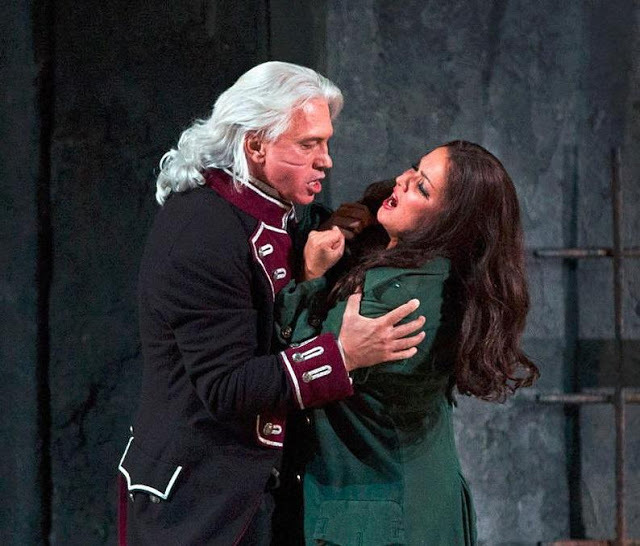
In the clutches of the Conte
Photo credit: Marty Sohl
Depending on how these roles are sung, the Conte can end up representing the manly alternative to the delicate blossom of Manrico’s young love, particularly when the troubadour is played by a singer as fresh faced and jejune voiced as Lee. After all, the Conte is given, from the outset, some of the most mature and moving musical expressions of human affection.

When he is portrayed as more than just an evil old man, lusting after a poor maiden in the throes of her first experience of love, new possibilities in the story arise. It all begins early in the score and libretto and continues up to the climax. At the end of Conte di Luna’s Act IV Vivrà duet with Leonora, the prey seemed to respond to her predator, at least in this particular performance. In a surprising turn of events, Netrebko actively initiated a kiss, pressing into Hvorostovsky passionately, fervently, as though she was indeed actually swept off her feet, rather than just making believe to deceive di Luna to get what she wanted. When Leonora goes off with him at the end, Netrebko in this case took charge – she was unequivocally the one who whisked him off the stage.


In the Russian soprano’s hands, the prey suddenly becomes the predator, making it clear that one take on this story is that the young Leonora gets over her first love with the feeble poet once she discovers the sheer seductive power of this bolder velvet-voiced specimen of manhood. It obviously only works with the likes of Dmitri in the role – irresistible barihunk that he is. And the seeds are nevertheless planted as early as the first act, if you are clued in and not reading him or playing him as a scowling monster, which is much more often the case.

Sorry, Manrico, this time the Conte gets the girl. At least for a fleeting moment, because of course her guilt is too much to bear and things don’t end well for anyone really. And that is what makes this drama only seemingly convoluted, but also so incredibly moving. When in the right hands it can be as cathartic as the best Greek tragedy.

At which point does the prey become predator?
Photo credit: Marty Sohl
Lei: The combination of Netrebko, Lee and Hvorostovsky brought a new twist to the opera’s love triangle. While the plot empathizes with the Leonora / Manrico pure and innocent bond, I found myself cheering for the apparently villainous Conte di Luna (or is he?). Putting aside the fact of Dmitri was the hottest singer on stage, his rendition of the character was of a man so deeply and furiously in love with a woman that he would defy God to keep her:

Invano un Dio rivale
s’oppone all’amor mio,
non può nemmeno un Dio,
donna, rapirti a me,
non può rapirti a me!*

The love of Conte di Luna is also the most profound, tender and mature love in the whole score. Think of the show stopping aria, Il balen del suo sorriso, where Dmitri soars with the most elegant and effortless legato, not to mention the emotional charge of a man exuberantly yet firmly in love that left me shedding copious tears.


This is possibly the most moving aria in the whole opera, which to me grounds the counterintuitive conclusion that the villain is a more profound love interest than the romantic hero. Frankly, any woman listening to Dmitri deliver Il balen del suo sorriso would pick him over the Troubadour. It’s really a no brainer. Remember, Manrico is the guy who dumps Leonora to run to save his mother (who is not even his mother and he kind of knows that too!):

Era già figlio prima d’amarti,
non può frenarmi il tuo martir...
Madre infelice, corro a salvarti,
o teco almeno corro a morir!**

Also, Manrico is quick to doubt Leonora when she tells him she saved his life, immediately jumping to the conclusion that she betrayed him with the Count and covering her with insults (Ha quest’infame l’amor venduto / This wretch sold her love). Little does he know that she already poisoned herself and will die shortly. So, really, Leonora, you deserve better: next time don’t take that poison, dump that momma’s boy and go home with the hotter and far superior Conte di Luna!

Lui & Lei

Charles Edwards' Goya-esque sets
Photo credit: Ken Howard
The tragic denouement
Photo credit: Marty Sohl

In vain a rival God
opposes my love,
not even a God is able,
O woman, to steal you from me,
is able to steal you from me!

** Before I loved you, I was yet her son;
your suffering cannot restrain me...
Unhappy mother, I hasten to save you,
or at least, hasten to die with you!