Showing posts with label Rob Howell. Show all posts

Wednesday, March 8, 2017

Massenet’s Stab at Sturm und Drang

Massenet’s Werther
Metropolitan Opera
February 20, 2017

Goethe's romantic hero gets a Massenet make over
Photo credit: Marty Sohl
Werther is one of those operas that I always want to like more than I eventually do. Based on Goethe’s slender little epistolary novel that took the world by storm when it first appeared, Massenet’s opera is just too laden with humdrum moments of musical fluff to really feel like it’s worth my while. The composer takes ages to set the quotidian tone of each scene and the big orchestral flourishes, which he primarily reserves for Werther’s emotional outpourings, as too few and far between. The rest of the story points are just not propped up in any satisfactory way.

The sorrows of the young poet
Photo credit: Marty Sohl
Seeing so many operas both in the mainstream repertory as well as the occasional rarity, revival or outlier really leads one to an appreciation of what makes an opera a canonical masterpiece. And, at least for me, it comes down to dynamic, multi-layered dramatic tensions couple, of course, coupled with tight, wonderful music (think Norma, for example). In the case of Werther, it’s just not there. The main drama here is that Werther loves Charlotte who is too stuck up to love him back and as a result he kills himself. Everything else is mostly filler. The music has a couple of terrific moments but otherwise it is rather unexciting. In those moments when the orchestra rises to sweep the eponymous hero off his feet into some sturm und drang, the tenor does find a little fodder to feed his fire and ours.

What brought us back to revisit the opera this time was the opportunity to see what the hit tenor Vittorio Grigolo would do with the role. And he certainly made for an ardent lover. He played the archetypal tragic romantic hero as an exuberant madman of sorts, the bright flame that burns itself out. Fast.

An ardent lover on the prowl
Photo credit: Marty Sohl
The pleasure of watching Grigolo perform is partly the warmth of his instrument that is often let to wander off the leash a little bit, which is what lends him an air of the dangerous or the unpredictable. It is expressive and so very Italian. And at the same time he often comes off as a bit of an over-wrought caricature of a romantic hero, which is perhaps both a limitation but also a part of his charm. On the one hand you cannot take him too seriously, but on the other Grigolo is terribly endearing because he is, in his over the top divo way, so in character.

In any case, he threw himself into the role of the tormented unrequited lover with a Neapolitan flair, devouring all of that male emoting like a drama king. Grigolo’s gripping breakdown in Albert’s study was forcefully gut wrenching. He brought an almost violent physicality to the scene that really left everyone involved shaken, including the audience.

The fiery little tenor was all uncontainable passion
Photo credit: Marty Sohl
As per her usual, Isabel Leonard struck a handsome figure on stage, though to my ear she lacked in volume singing Massenet’s French score. I don’t always find that to be the case with her. Regardless, she emoted beautifully, if regally, in her big moment in Act III. This is where the female lead gets to have her moment in the moody spotlight of the opera. She also carried the protracted death scene in Act IV with sentiment and conviction. When she picks up the pistol and pauses after Werther definitively gives up the ghost, you really are left wondering, just before the curtain drops, “Is she going to do it?”

Charlotte is all composure and restraint
Photo credit: Marty Sohl
At our last outing with this opera back in 2014, when the production debuted, Jonas Kaufmann sang Massenet’s tragic hero. Being one of the few times he actually showed up to sing on a night that I had tickets to see him, I recall being a little underwhelmed by his lack of volume and the underwhelming power of his voice. Though dramatically as an actor he was riveting, from all the videos I have seen of him in action I had expected his voice to be more compelling. Instead it hardly projected from the stage.

In Kaufmann’s hands the young poet is ostensibly more disturbed from the start. He wears his destiny on his person. It’s in his demeanor, the look in his eye, the way he walks and it’s in the way Kaufmann sings, the consummate solipsist, all closed up in himself. From the moment he steps onto the stage you are aware of the fact that this probably is someone capable of suicide. With Grigolo, who is more of a wild card, you really don’t know what it would take for some so ardently passionate to commit such an extreme act of aggression against his own person.


Indoor space rights the angles of the great outdoors
Photo credit: Metropolitan Opera 
The sets of the “new” production are quite stunning. Rob Howell’s designs incorporate a brilliant use of geometric architectural elements that either came into alignment or separated and went slightly askew to allow the natural world to break into the sphere of the civilized world. It nicely mirrors the eruption of the uncontainable passion of full-blown German romanticism into the rational order of enlightenment society. It is the Dionysian that encroaches on the Apollonian. All of the scenes in nature are pleasantly catawampus whereas those that play out indoors are dominated by the rationality of straight lines – all the angles get righted.

The poet goes down in a redemptive blaze of storm and stress
Photo credit: Ian Douglas
And so the pieces of the set slide apart and come together from one scene to the next until the space collapses into the claustrophobic bohemian apartment of the tortured poet. In the final scene that’s where we end up. As we magically zoom into his sad little room, the relatively simple stagecraft effects are mesmerizing. Werther is like a caged animal, restless, unsure where to turn, consumed by his own emotions. Here, momentarily, he is all storm and stress. The way the whole thing is orchestrated visually is uttering ravishing of all of the senses. Charlotte barges in on him once the shot has been fired. As the children’s voices chime like tinny bells of redemption in through the window singing their signature carol, in her embrace at last, he slowly expires. Ultimate defeat has never seemed so redeeming.

– Lui & Lei


The man who made suicide a "thing"
Photo credit: Marty Sohl

Sunday, December 4, 2016

Passion Italian-Style in WWII Paris

Puccini’s Manon Lescaut
Metropolitan Opera
November 25, 2016

Manon reminisces about simpler times
Photo credit: Ken Howard/Met Opera
The Met’s new production of Puccini’s first big breakthrough opera from 1893 is back for its second year in a row with a new cast. When we saw this production on the opening night of its run last winter, Roberto Alagna had stepped in to save the day due to an “unexpected” cancellation by the chronic canceller Jonas Kaufmann, opposite the gorgeous Latvian soprano Kristine Opolais. Back then it was our first Manon Lescaut and we liked it fine, though we did not feel it was something worth writing home about. This year, maybe because of the new (superior) cast or due to some Wagnerian exposure, we actually liked this Puccini highly melodramatic opera much better.

Manon unleashes her diva
Photo credit: Ken Howard/Met Opera
With the new cast, the dynamic tension between the characters shifted ever so slightly. Carlos Alvarez brought out his rich and lyric tenore spinto. His voice is vibrant and fits squarely in the Puccini canon. He played a cocky, headstrong des Grieux, with his male assertiveness coming across in his brutal attack on certain notes in key dramatic moments. His No, pazzo son in the climax of Act III turned out to be one of the most moving moments of the evening. I found that the threat of separation between the two lovers tugged on my heartstrings. Alvarez’s performance was gripping and the fact that I was virtually moved to tears completely blind-sided me. I usually find Puccini too sentimental, too saccharine, too sappy for my tastes, and yet he still manages to sneak up on me especially during scenes like this one that feature big bursts of muscular emotions set to music.  

When it comes to Anna Netrebko, it seems like she was born to sing this role. There is something about the way she embodies Manon that seems at first blush to be entirely out of character but that ultimately brings to the fore elements that you don’t usually see from other singers. While Netrebko and her voice seem a touch too mature for the Act I incarnation of this innocent country maiden who is on her way to a convent, she played her Manon as a fresh faced ingénue who was completely unaware of the innate diva-esque powers of seduction that she naturally possesses. It was a revelation in many ways, not least of all because she owned the role vocally, even while only feigning innocent naïveté. So by injecting her larger than life diva quality even in these nascent moments of Manon’s early blossoming, Netrebko endowed the character with something very special, not to mention fitting for what this young woman may in part also be deep down.

Manon possesses her inner diva
Photo credit: Ken Howard/Met Opera
In the first act, she discovers what she is capable of. In the second, she finds herself in a quandary of sorts. Having been forced by her opportunistic brother to leave the man whom she really loves, she uses her natural gifts to carve out a very posh niche for herself in the rarified Parisian world of the rich and famous in which she seems to serve as little more than a glorified whore. Clad in her plush full-length furs and surrounded by a slew of Art Deco luxuries, Netrebko dreamily croons In quelle trine morbide about missing the simpler life she enjoyed with des Grieux, her more passionate lover, the man whom she abandoned without even saying goodbye. She pines for those times when she had fewer toys but soaked up a whole lot more love, long kisses and amorous embraces.

In this case, Manon is actively a trickster. She knows exactly what she is doing when she manipulates des Grieux back into her embrace in Act II. She is a dangerous seductress using the only weapon in her arsenal as femme fatale, and that is her antico fascino che accieca. Poor des Grieux immediately falls for it, to his own knowing chagrin. Netrebko plays the moment beautifully. A slippery snake who knows the power she holds over men. Des Grieux then really sees through her deceit and artifice when she reverts back to her opportunistic materialist self after they are alerted that her arrest is imminent. Rather than high tail it out of there, she goes back to her boudoir for the jewels and the gold, and Alvarez breaks into one of his most heart wrenching numbers in the first half of the opera, Ah, Manon, mi tradisce il tuo folle pensier, which he belts out with a manly desperation. She continues to play him and he is distraught. It is in moments like this one that makes me think that Puccini really nailed it. This whole movement in the music and the narrative very concisely captures the spirit of Prévost’s novel, in which Manon is a cold blooded heartbreaker and des Grieux let's his crush get the better of him at every turn, yet he just can't help himself, and so he always goes back for more. Crazy he is indeed.

The Column of Trajan and the painting visible in the boudoir backdrop
Photo credit: Ken Howard/Met Opera
Set against the backdrop of a Nazi occupied France, Richard Eyre’s distinctive take on the opera opens in Amiens, France, only this time the year is 1941. The village of the original has been transformed into a provincial French township and the fashion has been adapted to match. On the whole the updated setting enlivens the story, despite initially feeling like another futile experiment in the modern history of operatic Regietheater. Upon further reflection, however, some of these directorial decisions do in fact add several insightful layers to the story as it stands. Not only does it come off completely sexed up – the costumes and sets look great – but it also introduces deeper motivations for such plot points as to why Manon is headed to a convent in Act I and as to why the arrival of the gendarmes in Act II is extra heartbreaking, not to mention the deportation twist in Act III.

Manon flirts with her sugar daddy
Photo credit: Ken Howard/Met Opera
Talking with a scholar of French literature and culture during one of the intermissions, I was taken by a particular insight that sheds some light on how we might go about decoding some of the liberties Richard Eyre took with this concept, especially considering the bold decision to set the opera in a France under German occupation in the year 1941, rather than the late 18th century (the novel is set in the first half of the 18th century, Puccini moves it to the second half of that century). The suggestion is that Manon is Jewish and like many rural Jewish girls of the time she is being shipped off to a convent in order to escape persecution – a relatively common occurrence. Then in Act II when the soldiers burst in to abscond with her, it is because Geronte has not merely denounced her for lechery, but rather that he has reported her Jewishness to the authorities. And so in barge the Nazis. A particularly cruel form of revenge for having found her in the midst of a tryst with her former lover and his prior rival. It’s a very powerful reading, and it very likely is what the director and his team were going for.

Not every aspect of the production fits into this reading and for it to work at all you have to use your imagination, particularly in Act IV. But the broad outlines of this notion seem to be there, and the direction makes every attempt to make it all mesh. The Act III role of the prostitutes and prisoners who are being shipped off as slave laborers to the new world would then seem to provide a parallel to the rounding up of individuals to be sent off to concentration camps. In fact, they are all systematically stripped down one-by-one during the humiliating roll call portion of the act and dressed in sad gray smocks with numbers stenciled on them, so Holocaust references would not be a stretch.

The Nazi deportation forces cart her off to the camps
Photo credit: Ken Howard/Met Opera
By the time we get to the final act, however, Eyre’s staging of Act IV only functions on the level of metaphor. The lovers find themselves in a wasteland, both the work of their all-consuming passion and of the war that has been raging on in the meantime. This is one of the main points in which the words being sung in the Italian are incongruous to the action on stage, and I usually find this practice harder to condone. The long slow death of the beloved nevertheless plays out against the backdrop of a war-ravaged cityscape and, when sung by the likes of Alvarez and Netrebko, it is a harrowing experience for all involved. An appropriately Wagnerian finale, a Liebestod in the Italian fashion, as Puccini intended it.  

The slithery snake sneaks up on her prey
Photo credit: Ken Howard/Met Opera
Rob Howell’s signature rotund set design (with striking similarities to his work in the Met’s current productions of Carmen and Le nozze di Figaro) cleverly includes in Manon’s courtesan quarters in Act II a mock up of the Column of Trajan in Rome that features an array of Kama Sutra poses and a screen with an enormous image of Cupid pinching Venus’ nipple from the iconic painting by Agnolo Branzino, The Allegory of Venus and Cupid. The part of the painting that is on full display includes the right side of the composition in which the monstrous figure of Temptation holds forth in one hand the promise of love and pleasure in the form of a honeycomb; in the other she holds the menacing prick of her scorpion tail. These elements provide a kinky backdrop against which Manon's big courtesan scene unfolds. It displays clues to the pain that will inevitably follow in the wake of love's great transitory pleasure, especially as these two lovers sing of lips that wound and heal – dolcissimo soffrir, indeed!

The set for this act must also include a great big bed and this makes Puccini powerfully unique. The libretto and the writing are among the most Dionysian outside of Wagner, but Puccini is Italian and so the quality is distinctly more warm-blooded. Just to read the text for the big love scene when des Grieux and Manon are reunited is to go on a trip to Venusberg that is not otherworldly, but profoundly of the here and now. It’s deep, if you let it work its magic on you. It can be a bit misleading for its verismo undertones, but to understand Manon Lescaut, it seems to me that you have to know not only Cavalleria rusticana, but also Tannhäuser and maybe even Tristan und Isolde, which makes it a perfect pairing for this season at the Met.

The wasteland provides the backdrop for the final movement
Photo credit: Ken Howard/Met Opera
Manon Lescaut’s Act II contains one of the deepest most Dionysian expressions of operatic abandonment in the Italian canon that I have seen. And it is only thanks to Wagner (of all people) that I have come to this understanding. This opera can take you places if you let it and it does contain raw bits of the Puccini works to come. The beginning gives you a glimpse of what is to come in the first act of La boheme. Act III gives you a glimpse of the winning formula that brought us the E lucevan le stelle movement in Tosca. And there are other prolepses of what is to come in Puccini’s later work. But his attempt to descend into the Dionysian in the second half of Act II and what happens in Act IV all amount to something very deep. This is not Verdi, and it’s not Wagner, nor is it the later Puccini. Richard Eyre’s production does not entirely disappoint.

– Lui & Lei

Tuesday, November 18, 2014

The Taming of the Gypsy

Bizet’s Carmen
Met Opera
October 28, 2014
Photo credit: Ken Howard / Met
Tonight revisiting Carmen, I was reminded why it’s such a blockbuster. With nine hundred and ninety two performances at the Met alone, Georges Bizet’s 1875 opera is immensely and effortlessly entertaining. It features wonderful music at every turn with a variety of different themes and Spanish-tinged melodies that are always fiery and pleasant to the ear. In terms of the plot, which is linear and very easy to follow, this is not an opera of nuance – dutiful, good-boy soldier falls for beautiful, free-spirited gypsy, who (maybe) loves him back (for a bit), drags him into an adventurous life of danger as an outlaw smuggler; soldier is not really made for this, but is crazy about his gypsy, while torn by remorse for not being close to his loving mother and not behaving like a good citizen; enter hot, free-spirited torero who whisks the beautiful gypsy away; soldier goes crazy with jealousy and stabs gypsy to death.

Photo credit: Met 
Although the story may be simple, the music is complex and multi-faceted and brings different themes alive with immediacy, power and expressiveness. Often times Bizet’s score switches the musical mood several times within a single scene to emphasize the various strands that are all going on at once so that in the span of only a few minutes the tone will change from celebratory to dangerous to loving, and then back to festive, really illustrating how the unity of the plot consists of a multiplicity of ideas that all work together beautifully.

Photo credit: Met
Young, passionate and energetic, Pablo Heras-Casado is the perfect conductor for Carmen, not the least because of his obvious Spanish sensibility, particularly evident in the opening of Act IV, which musically was one of the highlights of the evening. It is a fiery and breathtaking piece of music that conjures an intensely passionate mood in preparation for the emotional climax to come in the finale. Heras-Casado kept the whole opera moving at a brisk pace, distilling every nuance of the wonderful Bizet score. He really brought it to life for me like never before and made me realize that the music may actually be the true, and certainly the most complex, protagonist here.

Photo credit: Hioryuki Ito / NYT
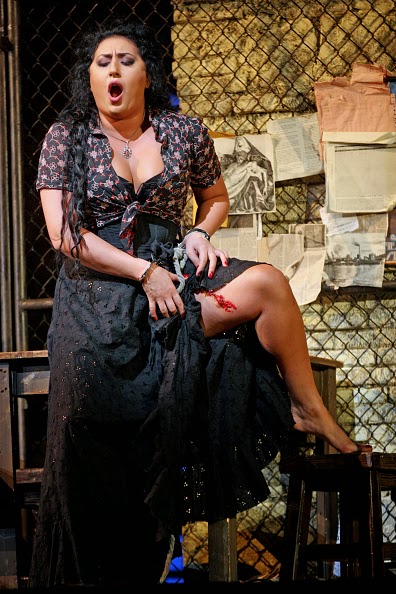
Georgian mezzo Anita Rachvelishvili is a force of nature, a veritable stage animal. Her acting was fierce, aggressive and sensual, as a Carmen should be and maybe even more – the intensity of her passion when initiating intercourse with Don Jose on a table caused a lot of tableware to fall to the ground (which was a realistic yet distracting effect). The rawness of her acting contrasted somehow with her singing, which was surprisingly graceful, and fluid throughout, almost nonchalant, a bit lacking in the guttural, expressive intensity that one would expect from a Carmen. She did achieve peaks of tragic passion in Act IV’s final confrontation with Don Jose, actually sending some shivers down my spine. Rachvelishvili was incredibly mobile on stage and also a great dancer, particularly in Acts II and III, where really embodied the gypsy nature of her character. This singer’s very physical stage presence was evident when we discovered her in Price Igor last year, but she was even more striking in this Bizet role that seems to have become her signature part since her La Scala debut in 2009.


Photo credit: Ken Howard / Met
Soprano Anita Hartig was an impressive Micaela, the loving good girl tending to Don Jose’s sick mother. Her character is Gilda-like and Hartig conveyed it with an angelic purity and innocence while at the same time soaring and effortlessly filling the space more than any of her other colleagues on stage. She left me wanting to hear more from her and I will look forward to seeing her again in a leading role in the future. Bass Ildar Abdrazakov exuded charisma as Escamillo. His entrance in Act II was a showstopper and a pleasure for the eyes and the ears alike. No wonder Carmen dumps that moping Don Jose for this sexy toreador, really a no brainer, especially when Abdrazakov is singing the role! Tenor Aleksandrs Antonenko as Don Jose was passable once he warmed up a bit and as long as he avoided high notes. I am just not crazy about the sound of his voice, particularly in the higher register. Though his sound can be grating on the ears, when he is in the young, naive and in love stage of his early character development, he was easier to palate, especially in the last two acts of the opera when he grows more jaded and angry at the world.

Photo credit: Ken Howard / Met
Frasquita and Mercedes may be minor roles but Kiri Deonarine and Jennifer Johnson Cano did an excellent job in bringing these two gypsies to life with verve and lightheartedness, while at the same time being vocally very strong and displaying great acting skills, they both left me wishing to see more from their characters. The Met’s chorus was as usual excellent, with a special mention for the kids’ section that was particularly delightful and fresh.

Photo credit: Beatriz Schiller
Photo credit: Ken Howard / Met
Rob Howell’s sets were essential and raw, with a circular crumbly stone-like structure serving as backbone for most of the opera, complemented by gates surrounding the square (Act I), Pastia’s bar and dance floor (Act II), mountainous elements (Act III) and the street outside the plaza de toros (Act IV). The simple decadence of the sets made them somehow a-temporal in a very refreshing way. It seems like one of director Richard Eyre’s signature moves is to imbue his overtures with a little does of stage action (think of this year’s Nozze). Here he chose to have each act’s overture/prelude punctuated by a couple of dancers performing the different stages of Carmen and Don Jose’s love story, which was a nice touch, particularly with red lighting that emphasized the violence and passion flowing through the opera. The direction was all in all pretty straightforward, with some particularly effective ideas in Act IV. The parallel between Carmen as a force of nature who needs taming and the bull whom matador arrives in the parade to strike down is really pounded into the audience full force in this production:

C’est l’Espada, la fine lame,
celui qui vient terminer tout,
qui paraît à la fin du drame
et qui frappe le dernier coup!


As Escamillo enters in full regalia on his way to the bullring, the chorus sings a metatextual reflection of what happens in the final seconds of the drama. And the last image Eyre leaves us with is a split-frame glimpse of the corpse of Carmen on one side of the stage and her virtual mirror image in the cadaver of the bull that is revealed once the circular stage spins open and the bullring after the bullfight is brought into view. Like the sacrificial bull, Carmen has been laid low, her carefree toying with men’s emotions has back to haunt her. And the story spins full circle.

- Lei & Lui
Photo credit: Ken Howard / Met
Photo credit: Met  
Photo credit: Ken Howard / Met
Photo credit: Met