Showing posts with label Falstaff. Show all posts

Sunday, August 24, 2014

The Revelation of Salieri's Falstaff

Antonio Salieri’s Falstaff, ossia le tre burle
Dell’Arte Opera Ensemble
August 14, 2014 – East 13th Street Theater

Falstaff puts his moves on
Photo credit: Richard Termine / The New York Times
Lei: Who knew Salieri was so much fun? I’m not sure why he rarely gets performed anymore. It has often been said that if it were not for Mozart, Salieri would have been the greatest of his day. I don’t know about that, but experiencing his Falstaff (1799) firsthand sure made it crystal clear that the two composers were contemporaries. Salieri sounded very Mozart-y (or is it the other way around? Still, this opera opened nine years after Wolfie's death in 1791). Either way, we immensely enjoyed this opera as delivered by Dell’Arte OperaEnsemble. It was sheer entertainment that elicited a handful of belly laughs and kept us on the edge of our seats to see what came next. The musical range of the score was thrilling: stock-in-trade opera buffa comic arias alternated with passages of tragic desperation and playful romantic duets, all the while it maintained an airy lightness at its core that made this opera a truly a pleasure to discover.

A very '80s Herne the Hunter
Photo credit: Brian Long 
Lui: Salieri introduced Shakespeare’s larger-than-life loser-in-love to the operatic stage almost exactly a century before Verdi who famously turned to the same material at the end of his career. While the works of both composers proceed along the same plot lines borrowed from Shakespeare’s The Merry Wives of Windsor, Salieri’s version is by far the more streamlined of the two. For example, the love affair between Fenton and Nannetta is conspicuously missing here, and as a result the whole show skips along at a quick and sprightly pace. Other than the missing young love story, most of the major differences between the two merely come down to a change in focus.

Lei: While for Verdi the main focus is really the Falstaff character with his comic but also tragic sides, Salieri presents a Falstaff that (at least musically) is largely just comic. The tragic star of Salieri’s opera is arguably Mr. Ford, who provides an emotional counterpoint to the foibles of the great John Falstaff, especially in the first half of the opera. In Salieri’s version, Mr. Ford definitely has more airtime than he does in Verdi and seems to ground the emotional core of the opera with his numerous passionate arias of a distressed jealous husband.

Jealousy gets the best of Mr. Ford
Photo credit: Brian Long
Lui: One great scene of dilation in the Salieri score is the aria “Or gli affannosi palpiti” that lends insight into the inner-workings of the jealous mind. It bears an undeniably Mozartian influence – plaintive bars borrowed from Così fan tutte’s Ferrando crossed with the melancholic melodies of Don Giovanni’s Don Ottavio. Distraught and flustered by the thought that his wife could actually be cheating on him with the loose cannon Falstaff, Mr. Ford ponders his options. Director Louisa Proske stages this moment beautifully. With the house lights off, she places him in a single spotlight with his back up against a black brick wall in the back of the theater. All eyes are on him as he gives us a glimpse into his troubled soul. The music slows down a bit here, which allowed tenor Erik Bagger to really dig into the fuller potential of his youthful instrument, despite some of his vocal limitations during some of the faster passages. In fact, this is perhaps the moment in which he gave us some of his best singing of the night. I was thoroughly captivated as he progressed from pained despair to near frenzied madness only to decide that he will bear arms to seek revenge on his wife and her liaison and anybody else who might get in his way. It was a powerful scene that added depth to an otherwise light and jaunty comedy.

The fairies teach Falstaff a lesson
Photo credit: Brian Long
Lei: There was never a dull moment in Louisa Proske’s staging. Set in the 1980s, this stylized production was extremely effective in each of the simple effects it sought to accomplish. With just a few props and excellent direction, Proske’s managed to create a whole universe of suburban bourgeoisie (the Fords’ plush sofas) that clashed with Falstaff’s squalid decadence (one wobbly chair). Both scenes set in Mistress Ford’s bedroom were pure comic delight. Proske’s move to make Falstaff mimic an ottoman under a throw was simple yet charming. And the tables are neatly turned in a perfect act of poetic justice when on the second go around it is Mr. Ford who ends up under a pile of dirty laundry. The finale in the woods worked equally well. The leading ladies sport bunny-ears as they cajole a ridiculous Falstaff in his yellow jumpsuit and huge horns, before they go on to lead a daunting group of fairies in green ponchos and carnival masks to teach the horned buffoon a lesson. The work of choreographer Sam Pinkelton was also very successful throughout, with dancing that was high energy, accurate and in beautiful harmony with Salieri’s score, from the disco moves in Act I’s suburban house party to the fairies’ feast in the finale. There was nothing amateur at all about this low budget production, at least in cast A’s performance of it.

The irresistible John Falstaff
Photo credit: Brian Long
Lui: Shakespeare’s Falstaff is one of the bard’s most charming creations and baritone Gary Ramsey embodied him with panache. Though his Italian could use a little work, his acting was brilliant (and not surprisingly so, since Ramsey came to opera from the acting world). His Falstaff is potbellied and, with few exceptions, only ever dons the same light blue leisure suit and his signature canary yellow tuxedo shirt with its frilly front and a dashing bow tie. He is the self-absorbed creep par excellence. And boy could he shake his thing! Rather than accentuate the disconnect between his former life in the court of Henry IV and his new life in the provinces, Ramsey’s Falstaff in Proske’s rendition is out of place inasmuch as his whole sensibility is leftover from his salad days in the 1970s, an earlier era when he was potentially “in his prime.” He now finds himself a swinger stranded in the brave new world of the 1980s, amidst the working class stiffs of the suburbs no less.

Lei: After Falstaff, soprano Marie Masters in the role of Mistress Ford truly stole the show. Masters is a fiery and feisty force of nature. She owned her numbers musically, singing her devious wiles both alone and in duet with Mistress Slender, and she acted up a storm. Masters played the faux-docile wife, the slinky seductress, the devious schemer, not to mention the clueless German bimbo, and every step of the way her stage presence was a thrill to watch. She really brought the role to life like a pro, with equally excellent Italian and German diction.

Mistress Ford runs the show
Photo credit: Brian Long

Mr. Slender and his sweater
Photo credit: Brian Long
Lui: Playing second fiddle to Mr. Ford’s quasi-slighted husband, Mr. Slender owned in every way his first act aria “Venga pure il cavaliere.” Baritone Scott Lindroth embodied the dweeby 1980s suburban husband with an adroit comic touch. The aria features an extended passage in which Mr. Slender, who suspects that Falstaff is up to no good with the local women, mimics a flirty conversation between Falstaff and his own Mistress Slender. Lindroth’s voice was explosive yet full and round as he alternated between the male and female roles in the fanciful dialog that plays out in his mind, though it was particularly mellifluous as he impersonated with gusto the full-chested Falstaff, whom he imagines in the act of putting the moves on his poor, innocent yet intransigent wife. Mistress Slender and her husband both let me wanting to hear more from them. They do not get enough airtime to showcase their talents. Heather Antonissen pulled off Mistress Slender’s big first act aria, “Vendetta, sì, vendetta,” with power and poise. Her voice rang out in the intimate space clean and clear, her Italian pronunciation was excellent and expressive. I would have liked to see her talent showcased in another couple of arias. In her ensemble pieces and duets, she always blended voices nicely with the rest of the cast, especially with Mistress Ford.

Mistress Slender plots her revenge
Photo credit: Brian Long

Lei: Dell’Arte reconfirmed itself as a top-notch independent opera company. Everything they do is thoroughly thought out and beautifully executed. This is the third Dell’Arte production we see (after L’incoronazione di Poppea and La clemenza di Tito last year) and they yet again breathed fresh air into opera, with innovative costuming and staging all while remaining true to the core of the work and delivering very serious musical performances, at times even with sparkles of extraordinary brilliance and promise. The efforts of artistic director Christopher Fecteau to adapt full orchestra scores to the chamber setting are truly impressive, and allow this opera company to perform great works on a smaller scale – truly a gift for young performers and audiences alike. Can’t wait to catch their Macbeth this week and see how they’ll make Verdi fit into the tiny East 13th Street Theater.  

– Lei & Lui

The 1980s are back. And they're bad!
Photo credit: Brian Long

Sunday, January 26, 2014

Elisir and Other Love-Drugs

Donizetti’s Elisir d’amore at the Metropolitan Opera
January 17, 2014

Adina (Netrebko) reading the story of Isolde's love elixir
Photo credit: Ken Howard / Metropolitan Opera 
Lui: It is a truth universally acknowledged that all you need is love. But what does one need in order to procure that love in the first place? Many of the characters in Donizetti’s deceptively deep Elisir d’amore put forth assumptions of their own, and over the course of Act I several hypothetical elixirs are proposed. What is it that makes someone fall for you? Is it country bumpkin Nemorino’s simple-minded, bull-headed persistence or the way he shakes his hips in the charming little dance he does? Do words alone do the trick in the form of desperate pleas? Or are “i soliti sospiri,” the sighs of a lover’s lusty desire enough? Is it army sergeant Belcore’s gallantry, his boastfulness, his overweening self-confidence? Or is it chemical? Is there a drug you can take to procure the desired effect, like quack doctor Dulcamara’s famous fleeting elixir? “In quel cor non son capace lieve affetto ad inspirar,”* Nemorino proclaims in his first aria. And so, in what is truly the show’s opening number, we are presented with the question pervading the whole opera: What is it that makes us capable of inspiring that highly sought after “lieve affetto” in the soul of the object of our affection.

Nemorino (Vargas) sighing over his love 
Photo credit: Ken Howard / Metropolitan Opera
After failing with his usual routine of supplication and debate, Nemorino changes tack and seeks his expedient for love from the itinerant confidence man posing as a doctor. While he waits for the “buon Bordeaux” he bought in the guise of a mythical-medicinal “elixir of love” to kick in, Nemorino starts to ignore Adina, the woman he desires. And as it turns out, this is what starts to change the tide in his favor. Once cold to his every affront, Adina slowly warms up since she suddenly misses the attention he used to lavish on her. By the end of Act I, it seems that playing hard to get is the best way to prod her into love. In addition, Adina responds sympathetically to Nemorino as he is brutally pushed around by Belcore in front of the townspeople. Love may also stem from her compassion for this poor man’s plight.

Mariusz Kwiecień as a playful Belcore in 2012 
Photo credit: Metropolitan Opera
Lei: Adina’s pity for Nemorino was particularly enhanced in this run of the production, where Belcore was played by Nicola Alaimo, a very corpulent Italian baritone who portrayed the sergeant’s arrogance as cruel, abusive and brutal. Quite a difference from when we first saw this production in the 2012 season opening gala, when this same character was played by the sexy Polish baritone Mariusz Kwiecień, who interpreted Belcore’s boastfulness as playfully charming and sardonic, coming off as the jerk women can’t help but like. When Adina flirts with a Belcore as attractive and fun as Kwiecień, one can think that she may actually be into him and perhaps also want to have some fun together, in line with her initial spiel about free love. On the other hand, if Belcore is of an unappealing Falstaffian size and demeanor, it is clear that Adina never really falls for him but is just going along with his advances mostly to appease a threatening invading soldier. Nicola Alaimo’s singing was very strong and dominating as Belcore, giving a darker, scarier twist to a character that is often played as simply an entitled womanizer.

Belcore (Kwiecień) makes Adina (Netrebko) swoon
Photo credit: 
Sara Krulwich/The New York Times
Belcore (Alaimo) scares Adina (Chuchman)
Photo credit: Andrea Mohin / The New York Times
 

Lui: It was like Falstaff fever had infected this year’s revival of last year’s new Bartlett Sher production. Belcore was played with the arrogance and overabundance of a Falstaff still in the prime of his military life (incidentally, Alaimo did play Falstaff at the Met earlier this season). It is amazing what a difference casting makes, even just physiologically.


Nicola Alaimo as a Falstaffian Belcore
Photo credit: Ken Howard / Metropolitan Opera 

Lui: In Act II further remedies for love are put forth: Does drunkenness turn a lover on? Or is money the true elixir of love? Wealth seems to be all the rest of the country girls are looking for in a man. As soon as they find out that Nemorino has suddenly become the recipient of an immense inheritance upon the death of his uncle, they descend on him like chicken on corn. But Adina sets the elixir story straight in one of her most beautiful duets with the itinerant quack, Dulcamara, this time sung powerfully by opera heartthrob, Erwin Schrott. “La ricetta è il mio visino,” she tells him when he tries to sell her his famous phony elixir as a solution to her amorous woes. She knows that her pretty face and feminine wiles are all she needs to attract her prey. No love-drug, not even a bottle of Bordeaux is necessary for a woman who knows how to play her charms.

Netrebko's high energy Adina
Photo credit: Metropolitan Opera
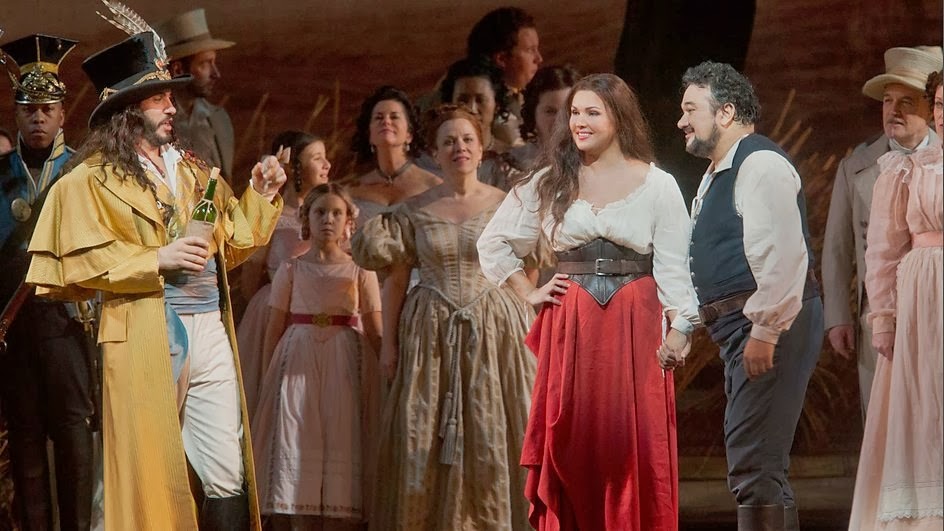
Lei: With explosive acting and singing, Anna Netrebko and her ex-partner Schrott were on fire. Against all rumors that she may have called in sick at the opening of this run of Elisir because she did not want to share the stage with him, Netrebko was in excellent form, maybe the best I’ve seen her so far. Her acting was really intense and high energy. Vocally strong, light, fast but also highly lyrical at times. I believe she can still deliver an outstanding Adina regardless of what some say (that her voice is now too chesty and mature for this character). Actually, she perfectly embodies the bossy, power-woman side of Adina. At the end of the day, she owns and manages a farm so a more womanly portrayal can definitely fit with the character. She exudes charisma and passion. Always been a fan, after tonight even more so.

Lui: The chemistry between the two of them was electric and playful and fun. Even if there was a little tension, they really played off each other nicely. The dynamic changes when they cast a hot young hunka hunka burning love like Erwin Schrott to play Dulcamara. It opens up the possibilities of a series of flirtatious exchanges between he and Adina, which is exactly what we got. Sparks were flying during their interaction late in Act II. Their banter was so vivid and lively when the quack doctor is trying to sell Adina on his magic love potion and she realizes that she has actually fallen for Nemorino that I found myself caught off guard by the sudden shift to Nemorino’s big aria as the melancholic refrain of Una furtiva lagrima kicked in.

A hot Dulcamara (Schrott) and a giggling Adina (Netrebko)
Photo credit: Ken Howard / Metropolitan Opera 
Ambrogio Maestri as a fatherly Dulcamara in 2012 
Photo credit: Ken Howard / Metropolitan Opera
Lei: While I’ve seen Dulcamara done as a young and sleek con artist (Ildebrando D’Arcangelo in Otto Schenk’s 2005 Vienna production), this is the first time I’ve seen him portrayed as a Jack Sparrow type. It worked and was fun, although Schrott’s acting often referenced the Johnny Depp character a bit too closely, a lighter hand would have probably worked equally well. Pirate looks aside, I liked Schrott way better than Maestri who, at least when we saw him last year, acted as a fatherly and condescending figure without much depth. Dulcamara’s portrayal by this hot Uruguayan bass-baritone had definitely more sex drive, as he seemed to be groping every peasant girl who happened to pass by and was very much bewitched by Adina’s “una tenera occhiatina” (though that may be because his real-life ex was as charming as ever). Schrott was also, together with Netrebko, the strongest singer on stage, really owning the Dulcamara character, with perfect Italian, playful crowd-pleasing acting and effortless vocal power. Yet another excellent baritone who is a pleasure for both the eyes and the ears.


Dulcamara - Jack Sparrow (Schrott)
Photo credit: Ken Howard / Metropolitan Opera 
Lui: Ostensibly set during something like the Italian Risorgimento with an invading army of foreign soldiers, this new production takes Nemorino’s simpleton a bit more seriously, casting him as a tormented soul who is smarter than anyone gives him credit for. During the overture he paces out in front of the curtain with a little notebook in which he jots down the poetic thoughts that aggravate his soul (however, he is still too dense to pick up on the finer points of the Tristan and Isolde story Adina reads to them). Later the soldiers are surprised to see that he knows how to write his name, a moment when in most productions he simply signs his life away with an “X,” which is all that is required of him since they take him for an illiterate country boy.

Nemorino (Vargas)
Photo credit: Ken Howard / Metropolitan Opera
Lei: Ramón Vargas looks and acting delivered an excellent Nemorino, sweet, funny and adorable. Definitely more convincing than Polenzani in this same production back in 2012, who played it almost Hamlet-like, constantly looking startled by the circumstances around him but without that lightness and boyish innocence that are quintessential Nemorino character traits and that Vargas portrayed so well. I wish I could have equally positive comments on Vargas’ signing but I am sorry to report that he confirmed my theory that these days there’s a devastating tenor famine. Do they not make world class Italian-style tenors anymore? Vargas started weak then warmed up and did a few good things, but delivered a merely passable Una furtiva lagrima that left me lukewarm. While the aria is about one furtive tear, if it’s done right my tears run copiously and I even sniffle a bit. All I experienced this time was a touch of extra eye moisture but no waterfalls whatsoever. So disappointed. Also, the fact that Vargas butchered quite a few Italian words (for some reason he kept pronouncing double consonants as singles) did not make him score any extra points


Act I sets
Photo credit: Metropolitan Opera
It’s funny how seeing the same production a second time can trigger very different reactions. When I first saw Sher’s Elisir in Spetmber 2012, I got out of the Met ranting and pouting, complaining about its blandness and unimaginativeness for an opening gala and excessive seriousness that betrayed the core of Donizetti’s masterpiece. While I stand by the non-gala worthiness of this setting, after seeing it again, I really enjoyed this production as traditional yet solid and handsome. One thing though I still cannot stand: the finale with folks lining up bottles of elixir on the front of the stage. It just does not work with the libretto and the spirit of Dulcamara’s final aria. I really think it’s more effective when the quack doctor and his assistants hand out elixir bottles to the crowd selling them as real love potions, having everybody buy them and instantly fall in love with their neighbors, in a love apotheosis with Dulcamara triumphantly exiting as the savior of the village.

Act II sets 
Photo credit: Metropolitan Opera
Lui: Barlett Sher’s new take replaced a slightly psychedelic, slightly cartoonish 1991 production that wore its illusions on its sleeve. Sets were lifted up and down and in and out during the performance so that the stagecraft was an element of the story itself. Though I was not convinced by Sher the first time we saw his work at last year’s gala, I have to admit that it grew on me this time. Having recently revisited the old production on DVD, this new one is definitely an improvement on the Met’s precious storybook take on Donizetti’s tightly woven, wrenching (I always cry) love story disguised as an opera buffa. Though in part I want to credit that to the thrilling cast we saw in it this year lead by conductor Maurizio Benini. It’s amazing how strong singers and compelling presences can make all the difference, particularly when stars like Netrebko and Schrott are in such good form.

Lei: We saw one of the most gossiped opera ex-couples deliver a terrific joint performance and, yes, kiss enthusiastically (on the mouth!) at curtain call – perhaps singing about the tricks of love with your ex at the Met is yet another elisir d’amore to add to our list.

Adina (Netrebko) smiling at Dulcamara (Schrott) – off character?
Photo credit: Ken Howard / Metropolitan Opera 


* “In her heart the slightest affection I am ever unable to inspire.”


Wednesday, January 8, 2014

The Savour of Falstaff

Met - January 3, 2014

Lei: Tutto nel mondo è burla - that’s how Verdi’s anti-hero Falstaff salutes the public in the composer’s last work: an ode to wine, food, women and earthly pleasures, because “life is nothing more than a joke.” And coming from the father of the most stirring operatic dramas, with heroines and their lovers tragically dying left and right, it’s quite a statement.


Photo credit: Sara Krulwich / The New York Times
Lui: Verdi’s farewell opera is indeed a very Boccaccio-esque romp in the realm of appearances, practical jokes, feints and pranks. The world of the Decameron’s signature beffe and burle. There is even a sort of umbilical cord refrain that repeats throughout the opera linking the Fenton-Nannetta subplot to a kernel of Boccaccian wit. It’s a quote from the seventh story of the second day of Boccaccio’s Decameron: “Bocca baciata non perde ventura, anzi rinnova come fa la luna” (“The mouth that has been kissed does not lose its savor, indeed it renews itself just as the moon does”). The young lovers, apparently avid readers of the medieval Italian author, quote it to each other in their flirty duets, and Nannetta always finishes Fenton’s sentence for him when he starts to utter it. Even the only truly romantic bit of the opera is, thus, a nod to the jesty Boccaccio.

Photo credit: Sara Krulwich / The New York Times
Lei:  Ambrogio Maestri carried the show, not surprisingly since he celebrated his 200th Falstaff performance during this run at the Met. What is truly impressive is that Maestri is only 43, and started performing this role at 31, when Riccardo Muti noticed him in Milan and worked with him on developing a “younger” voice for a role traditionally performed by older singers. Maestri’s acting was superb, with unexpected light and fluid movements and an effortless comic force dotted with a few strokes of tragic awareness. Also, it really makes a difference when someone with his articulation performs Falstaff, really savoring and owning every single word, doing justice to the richness of Boito’s libretto. Maestri was the only singer on stage 100% understandable at any given moment, while some of his colleagues’ Italian diction was not always as clear. 


Photo credit: Ken Howard / Metropolitan Opera
Angela Meade confirmed herself as a strong solid singer, who performed Alice Ford with verve and confidence. I found Meade’s acting to have improved, looking a bit more mobile on stage when compared to when I saw her in Ernani. Mezzo Stephanie Blythe was very impressive as Mistress Quickly, her deep dark timbre was so clear and powerful that she dwarfed everybody else, including Maestri. I’ve seen her before as Azucena in Trovatore but this was the first time I was so struck with the strength and fullness of her voice. Lisette Oropesa’s Nannetta was pretty good though at times her lyricism was a tad too frail for my taste. Her duets with Paolo Fanale’s Fenton were pleasant but lacked punch, coming across as more nostalgic than ardent young love. 


Photo credit: Catherine Ashmore / Royal Opera House
Lui: The setting is mostly successful in making the material more approachable, moving the action of the first act from a medieval tavern to a 1950s wood paneled hotel, where Falstaff gorges himself on room service. Carts of food litter his chamber. In addition to the symbolism of the environs Falstaff inhabits, the thematic importance of class difference is further conveyed through the contrast between the protagonist’s grandiose old world aristocratic outfits and the mid-century modern Mad Men sorts of costumes that adorn the rest of the cast. Setting a piece like this in the pivotal postwar period, with its explosion of suburban life so vividly represented by Alice Ford’s humongous yellow kitchen in Act II, is a perfect fit for the central tensions of the story. Falstaff is, after all, a decadent and debauched minor aristocrat trying to fit into a petit bourgeois society that is on the verge of supplanting the old order, the values of which he is the lingering embodiment, and that manages to have its way with him. In the final sequence the tables are turned (and quite literally so in Carsen’s choreography of the climactic scene) on the voracious appetites of our omnivore. The man who once held the fork and knife is now under the forks and knives of the bourgeois society that is out to teach him a lesson. He is now on the table being poked and prodded so he knows what it’s like to be on the other side of his careless appetites.


Photo credit: Ken Howard / Metropolitan Opera
Lei: While I am all for freshening up productions with modern takes, I cannot stand it when for the sake of modernization things are pushed too much and the action does not match the words that are being sung. This happened in Scene II of Act II, here set in Alice Ford’s kitchen, when the libretto makes multiple references to a paravento (dressing screen) that the ladies set up in a specific way at Alice Ford’s instructions and that serves as hiding place for Falstaff first and for Nannetta and Fenton later. In this production when folks mention the paravento they mean alternately a cupboard and a tablecloth. I recently saw a video of the 2001 La Scala production of Falstaff where a real paravento was used that not only corresponded to the libretto but also worked as a better theatrical prop since it divided the space with a split screen effect that was much better than hiding singers in a cupboard or under a table. Also, I did not fully understand the sense behind the crowd of men, dressed like private detectives, who stormed into Alice Ford’s kitchen and proceeded to throw stuff from all of her cabinets. While it may have been intended as an absurdist comic touch (many in the public laughed), to me it just seemed awkward.


Photo credit: Sara Krulwich / The New York Times
Lui: Perhaps it is meant to be a comment on the prewar social order that is now being undermined by consumerism on a different scale and of a different kind. The shower of suburban consumer goods that pours from the cabinets and cupboards of Alice Ford’s kitchen in the mad manhunt scene is reminiscent of the finale of Michelangelo Antonioni’s 1970 film, “Zabriskie Point,” with its surreal clouds of conspicuous consumption raining down from the sky after a desert mansion is destroyed in an presumably imaginary explosion. Carsen’s production of Falstaff seems to level a lighthearted critique of postwar capitalism. The suburban mores of Alice’s brave new world present a petty substitute for Falstaff’s corrupt aristocratic appetites. His love of endless bottles of Xeres, polli, tacchini, fagiani and acciughe finds its kindred spirit in her kitchen full of copious amounts of consumer products.

Photo credit: Ken Howard / Metropolitan Opera

Lei: On a separate note, do we really need to have a real horse chewing hay onstage at the beginning of Act III? I am not sure what bothered me more, its entirely superfluous presence or the public cheering for it. I saw on archive photos that in the London run of this production Ambrogio Maestri actually rode a horse in the park scene. My guess is that the riding may have been such a scary experience for all parties involved that this time they kept the horse on the side just munching hay, while Falstaff drinks mulled wine. In any event, while real livestock may be acceptable in Aida’s triumphal march in the outdoorsy Arena di Verona, dragging drugged beasts on any other operatic stage as some sort of extra realistic touch or comic relief is never a good idea. I think I may still be haunted by the couple of sad big grey dogs used for the Met's Anna Bolena hunting scene in 2011.

Photo credit: Sara Krulwich / The New York Times
Lui: The absurd and unnecessary exchange with the horse is actually one of my favorite scenes in the opera. This is where Falstaff seems to have reached rock bottom. He has been thrown out with the dirty laundry and he’s hanging himself out to dry in what we could call, in the arc of his character development, his deepest darkest cave.


Io, dunque, avrò vissuto tanti anni, audace e destro
Cavaliere, per essere portato in un canestro
E gittato al canale co’pannilini biechi,
Come si fa coi gatti e i catellini ciechi.
Che se non galleggiava per me quest’epa tronfia,
Certo affogavo. Brutta morte. L’acqua mi gonfia.
Mondo reo. Non c’è più virtù. Tutto declina.
Va’, vecchio John, va’, va’per la tua via; cammina
Finché tu muoia. Allor scomparirà la vera
Virilità dal mondo. Che giornataccia nera!*


In this bit, the musicality of the language of Boito’s libretto is phenomenal. His spirits are crushed and the sound of his words are heavy and gloomy. His couplets rhyme on sounds like biechi and ciechitronfia and gonfiavera and nera. Then he takes his fateful first sip of mulled wine, which opens his eyes and his mind to the brighter side of life and the sound of his language follows suit.

Buono. Ber del vin dolce e sbottonarsi al sole,
Dolce cosa! Il buon vino sperde le tetre fole
Dello sconforto, accende l’occhio e il pensier, dal labbro
Sale al cervel e quivi risveglia il picciol fabbro
Dei trilli; un negro grillo che vibra entro l’uom brillo.
Trilla ogni fibra in cor, l’allegro etere al trillo
Guizza e il giocondo globo squilibra una demenza
Trillante! E il trillo invade il mondo!...**


Photo credit: Ken Howard / Metropolitan Opera
His solitary reflection on the pleasure of drink is punctuated by alliterative speech patterns full of internal rhymes on the sounds of words with rolling R’s and double L’s. The rapid succession of
trillo, grillo, brillo, allegro, squlibra, and trillante all roll off the tongue like a birdsong. His newfound happiness is inscribed in the text itself. Now Verdi is famous for his drinking songs and I’ve counted one in virtually every Verdi opera I’ve yet to see: from Libiam nei lieti calici in La Traviata to Ernani’s Evviva, beviam beviam, a libation is never lacking. In Falstaff, Verdi gives us different kind of ode to wine. This time it is melancholic and solitary but uplifting nevertheless.


Lei: This was my first live Falstaff and I had low expectations of enjoying it much due to its unconventional format (no real arias, music often feeling like schizophrenic virtuosism). Three things made me reconsider after seeing the Met’s production: the complexity of the libretto, the highly pleasurable action on stage and Levine’s electrifying conducting. Boito’s language is rich and poetic while at the same time light and funny, with lines such as “L’enorme Falstaff vuole / entrar nel vostro tetto / beccarvi la consorte / sfondar la cassa forte / e sconquassarvi il letto.” (“the enormous Falstaff wants / to enter your house / pinch your wife / break open your coffer / and smash your bed”). Maybe the cast was excited about working with James Levine or Robert Carsen’s direction deserves the credit. No matter the reason, the action on stage was energetic and accurate across the board, bringing to life the score and the libretto as a delightful yet explosive package. James Levine made fireworks out of Verdi’s music, with an intensity and pace that left this Falstaff skeptic out of breath – in a good way.

Photo credit: Sara Krulwich / The New York Times
Photo credit: Ken Howard / Metropolitan Opera

* I, then, having lived so long as a brave and skillful Knight, end up carried in a clothes-basket, tossed
in the river with the stinking wash, like a kitten or a still blind pup. Without this buoyant paunch, I’d surely have drowned. A nasty death. Water swells me! Evil world! There’s no honor left, all goes to pot. Go, old Jack, go thy ways; travel until thou’rt dead. Then true manliness will be gone from the world. What a black day!

** Good. To loosen one’s vest in the sun and drink sweet wine. A sweet thing! Good wine chases away the gloomy thoughts of sorrow, lights up the eye and one’s thoughts; from the lips it rises to the brain, wakening the fairy smith of trills, a black cricket who sings in the reeling brain, waking to trills every fiber of the heart. The joyous air quivers to the trill, a thrilling madness intoxicates the happy globe, the trill quivers through the entire world!