Zeffirelli's grand Orientalist extravaganza Photo credit: Marty Sohl
After having seen just a few hours earlier the Goya-dark and
emotions-stirring Trovatore matinee, the Turandot evening
show on the very same stage felt like a kitschy operatic Disneyland – all glitter but no depth or
complexity of any sort. And we experienced Puccini’s Oriental extravaganza in
its best possible form (Zeffirelli’s grand production) with a sensational cast
(Goerke, Alvarez, Gerzmava). The performance was truly spectacular, the way a Turandot
should be. One could see why this is a house-filling blockbuster: elaborate
sets that create an exotic fantasyland, extremely straightforward fairy tale
plot and dozens of dancers and singers swarming all over the stage, doing all
sorts of eye-catching stuff. Had I seen Turandot any other evening, I
would have probably been pretty excited about it, but catching it on the same
day I witnessed the best Trovatore ever, I really could not help but
compare the two operas and the Verdi one was the clear winner for me, mostly
because I found the plot way more multi-layered, relatable and interesting than
Puccini’s. No matter how gorgeous the music, if the narrative does not
captivate me, I simply don’t enjoy an opera as much.
Disneyland glitz in all its glory at the Met Photo credit: Marty Sohl
Putting aside the sets’ many bells and whistles and the excellent
lead singers, the Met Orchestra and the Met Chorus, led by maestri Paolo
Carignani and Donald Palumbo, respectively, were the true
protagonists of this piece. The orchestration was through the roof. I never
heard the Met Orchestra playing like that. So loud, so full. So grandiose. And
the Met Chorus as the Peking mob and the court at Turandot’s imperial palace
was truly sensational and carried the opera through, matching the explosive
grandiosity of the orchestra.
Calaf mourns the loss of Liu Photo credit: Marty Sohl
When it comes to Turandot’s individual singers and smaller
ensembles, though, while there were many perfectly enjoyable moments, very few
were memorable or captivating to me. And not for any singer’s fault. It’s just
that the opera itself does not have more than a handful of truly compelling
arias, basically Nessun dorma by prince Calaf and Tanto amore segreto
by the loving slave Liu before she kills herself. Nessun dorma is
one of the most famous operatic arias ever, as Sir Denis Forman put it in Night
at the Opera, this “wonderful aria shines out, pure Italian gold, amidst
all the surrounding exotica. It has a sweeping line, a great climax and if you
don’t fall for this you might as well give up hope of a good relationship with
Italian opera.”
Timur and his faithful Liu fare their way Photo credit: Marty Sohl
The Argentine tenor Marcelo Alvarez was a force of nature
as Calaf. This singer is growing on me every time I see him. He truly rides
orchestras and has a manly melodic power that is a pleasure to hear and at
times pretty gut stirring, too. I particularly liked his soaring Nessun
dorma and the power with which he attacked his responses to the three
riddles. Russian up-and-coming soprano Hibla Gerzmava was a moving and
intense Liu. I will be interested to see her again in other roles. American
dramatic soprano Christine Goerke as the ice princess Turandot had
impressive and almost thunderous power, however, her lines are pretty
declamatory in nature and there’s not much expressivity that can come out of that
no matter how good the singer.
Trovatore and
Turandot together total more than Die Meistersinger, however,
after spending over six hours at the Met, I actually felt pretty exhilarated
about the Verdi + Puccini operatic overload – which I could not really say
after equally long yet painful Wagnerian experiences. Just another confirmation
of the fact that I can take Italian opera in huge doses but continue to have
digestive issues with Wagner...
– Lei & Lui
The ice princess Turandot remains impenetrable Photo credit: Marty Sohl
Dmitri Hvorostovsky just keeps fighting back Photo credit: Marty Sohl
Lei: My absolute favorite
villain-playing baritone, the silver-haired, intriguingly handsome and
velvet-voiced Dmitri Hvorostovsky, announced back in June that he was
cancelling all future performances (including Il Trovatore at the Met)
due to treatment for a sudden brain tumor. The news came as a
terrible shock, especially since Dmitri exudes that action-movie-hero-operatic-rockstar
aura of invincibility. But then, at the end of September, Hvorostovsky
announced that he was actually going to sing three October dates of Trovatore,
during a break from his treatment.
Lui: We obviously rushed to
get tickets as we definitely could not miss him and wanted to show our support
for an artist we admire so much. And that is how we ended up lining up two
operas in one day – Trovatore matinee for the love of Dmitri and
an evening show of Turandotfor which we already had tickets.
Lei: With Dmitri’s plight on
my mind, I came to this performance of IlTrovatore already
feeling more than just a little emotional and I came out of it blissfully
weeping for a number of great reasons, as it was easily the most perfect and
deeply gratifying performance of Il Trovatore that I have ever
experienced.
The gypsies working away at their furnaces. Photo credit: Ken Howard
While I’ve seen David McVicar’s Goya-inspired production on at
least two other occasions, it never much spoke to me. This time was different.
Maybe it was one of those rare occasions where every singer on stage was top
notch, or maybe Dmitri inspired everybody to give their best. Whatever the
reason, the lead cast and the terrific Met chorus and orchestra (led by the fierce Marco Armiliato) brought the opera to life in a way that it felt like
discovering IlTrovatore for the first time, seeing it in a new,
more vivid light.
Kocán sets the stage. Photo credit: Ken Howard
Lui: Even the plot,
traditionally considered unnecessarily convoluted, made perfect sense to me.
One just needs to be attentive to the backstory as it is very clearly laid out in
the very first scene when the troops’ captain Ferrando, played by the excellent
Stefan Kocán, narrates in his seductive bass how the youngest of the previous Conte di Luna’s sons went missing. And the rest of the opera just
flows from there. He had me on the edge of my seat during this opening
exposition aria. With starts and stops he pulls his listeners in. I was hanging
on his every word like never before.
Lei: Every time I see this singer I lament the lack of more extensive bass roles in the operatic repertoire, as I really would like to hear more from him. Kocán’s instrument is smooth
and thunderous, with a menacing edge, and, all in all, exudes a quintessential
manliness. As Ferrando, he made a sensational opening with his aria Di due
figli, telling the tale that is really the origin of several
dramatic tensions running through the opera (infanticide, avenging fury,
maternal and filial love, outcasts vs. ruling class conflicts). Kocán sets the
tone for the evening from the get-go, permeating this aria with a hypnotic and
captivating force that remained constant throughout.
Lui: After more than two
decades of absolutely owning the role, it is abundantly clear that Dolora
Zajick was born to sing the gypsy Azucena. She has all the vocal moves. I
particularly appreciate the way she transitions from her head voice, intoning
Verdi’s soaring bel canto lines, to her chest voice, dropping into more
guttural jarring notes through which seeps the fervor of her anger against the
ruling class. Over the years, I feel like her voice has only gotten deeper,
making her even more perfect for this role. Zajick is entrancing to listen to
as she recounts her trials and tribulations as a mother forced to sacrifice her
infant son as the child-swapping plot thickens.
The big reveal: Azucena and her adopted son Photo credit: Marty Sohl
Lei: Her Azucena is definitely
one of the emotional cores and driving dramatic forces of the opera. Her final line Sei vendicata, o madre! (mother, you are avenged!) when Manrico is executed was chilling and almost demonic. Zajick
perfectly embodies the conflicting nuances of a vengeance-driven yet lovingly maternal
character, who cannot help getting her offspring (both biological and adopted)
killed in order to avenge her own mother burnt at the stake. Rigoletto and Lucrezia Borgia come to mind as other Verdian variations on this theme of a parent causing the tragic death of his/her own child.
Lui: Slight of build and
svelte of gait, Yonghoon Lee brought a youthful exuberance to the role
of Manrico. But he was also entirely self-assured, which lent an air of composure
to his demeanor. Not to mention the fact that his instrument is decidedly manly.
As a tenor, he is satisfying in his poignant delivery of the filial affective
core of Verdi’s opera. He was confident of his place in this world and his
voice rang out strong. I had been curious to catch him live and I look forward
to more. He obviously has what it takes.
The heart-wrenching loss of young love Photo credit: Ken Howard
Lei: While I found Lee
powerful, expressive and technically accurate I was not blown away in any soul
stirring melting way. His is a clean, strong voice but lacking that streak of
male sensuality I look for in a tenor. Also, I was not particularly captivated by
his acting and stage presence that, other than in Di quella pira when Lee was all fiery and up in arms, I found a bit flat when compared to the
intensity of the other singers on stage.
Lui: Anna Netrebko
sounded better than ever. Her Italian has really come a long way. Usually
brutal with the nuances of her pronunciation of the Italian language, this
afternoon I could make out every syllable of every word she sang. And this
really stood out to me. She was angelic and lovey dovey. In Il cor s’inebria,
I was moved by the conviction of her young love. At turns, she was receptive to
her two suitors; at others she was downright fiery and feisty. We even see her
ramping up the gate in the scene where she pines for her lover who is locked
away in the tower. That is, before she really comes to the realization that her
feelings may lie elsewhere.
Leonora at the rampart Photo credit: Marty Sohl
Lei: And that’s where Dmitri
Hvorostovsky comes in. The show really belonged to him. The Siberian singer
was in top form, despite his ailment. His baritone was insanely manly, yet
lyrically tender at the same time. As usual he had an amazing stage presence.The Conte di Luna is really a role that gives him a lot to work with. He is the evil villain but also has ample room to show his soft side, which is just how malleable
I came to discover this character to be.
Lui: Di Luna is often played
like a dirty old power-hungry fiend, but he can also be played with a more
mature sense of his sensual self, which in my mind is even more in line with
certain nuances of the score and narrative flow. From the moment we are
introduced to the Conte in Act I, his Tace la notte parallels Leonora’s Tacea
la notte placida, which it immediately follows. Are we meant to see them as
subconsciously already on the same wavelength? And then the depth of his
feelings is juxtaposed to those of Manrico when the troubadour can be heard
sweetly strumming his lute and faintly serenading his love from offstage (dolci si udiro e flebili / gli accordi d’un
liuto).
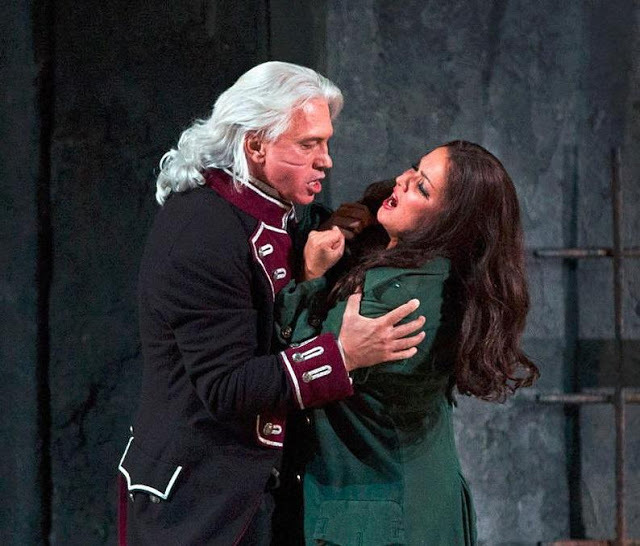
In the clutches of the Conte Photo credit: Marty Sohl
Depending on how these roles are sung, the Conte can end up
representing the manly alternative to the delicate blossom of Manrico’s young
love, particularly when the troubadour is played by a singer as fresh faced and
jejune voiced as Lee. After all, the Conte is given, from the outset, some of
the most mature and moving musical expressions of human affection.
When he is portrayed as more than just an evil old man, lusting
after a poor maiden in the throes of her first experience of love, new
possibilities in the story arise. It all begins early in the score and libretto
and continues up to the climax. At the end
of Conte di Luna’s Act IV Vivrà duet with Leonora, the prey seemed to
respond to her predator, at least in this particular performance. In a surprising
turn of events, Netrebko actively initiated a kiss, pressing into Hvorostovsky passionately, fervently, as though she was indeed actually swept off her feet, rather
than just making believe to deceive di Luna to get what she wanted. When Leonora goes off with him at the end, Netrebko in this case took charge – she was unequivocally the one who whisked him off the stage.
In the Russian soprano’s hands, the prey suddenly becomes the
predator, making it clear that one take on this story is that the young Leonora
gets over her first love with the feeble poet once she discovers the sheer
seductive power of this bolder velvet-voiced specimen of manhood. It obviously
only works with the likes of Dmitri in the role – irresistible barihunk that he
is. And the seeds are nevertheless planted as early as the first act, if you
are clued in and not reading him or playing him as a scowling monster, which is
much more often the case.
Sorry, Manrico, this time the Conte gets the girl. At least for a
fleeting moment, because of course her guilt is too much to bear and things don’t
end well for anyone really. And that is what makes this drama only seemingly
convoluted, but also so incredibly moving. When in the right hands it can be as
cathartic as the best Greek tragedy.
At which point does the prey become predator? Photo credit: Marty Sohl
Lei: The combination of
Netrebko, Lee and Hvorostovsky brought a new twist to the opera’s love
triangle. While the plot empathizes with the Leonora / Manrico pure and
innocent bond, I found myself cheering for the apparently villainous Conte di
Luna (or is he?). Putting aside the fact of Dmitri was the hottest singer
on stage, his rendition of the character was of a man so deeply and furiously
in love with a woman that he would defy God to keep her:
Invano un
Dio rivale
s’oppone
all’amor mio,
non può
nemmeno un Dio,
donna,
rapirti a me,
non può
rapirti a me!*
The love of Conte di Luna is also the most profound, tender and
mature love in the whole score. Think of the show stopping aria, Il balen
del suo sorriso, where Dmitri soars with the most elegant and effortless
legato, not to mention the emotional charge of a man exuberantly yet firmly in
love that left me shedding copious tears.
This is possibly the most moving aria in the whole opera, which to
me grounds the counterintuitive conclusion that the villain is a more profound
love interest than the romantic hero. Frankly, any woman listening to Dmitri
deliver Il balen del suo sorriso would pick him over the Troubadour. It’s
really a no brainer. Remember, Manrico is the guy who dumps Leonora to run to
save his mother (who is not even his mother and he kind of knows that too!):
Era già
figlio prima d’amarti,
non può
frenarmi il tuo martir...
Madre
infelice, corro a salvarti,
o teco
almeno corro a morir!**
Also, Manrico is quick to doubt Leonora when she
tells him she saved his life, immediately
jumping to the conclusion that she betrayed him with the Count and covering her
with insults (Ha quest’infame l’amor
venduto / This wretch sold her love). Little does he know that
she already poisoned herself and will die shortly. So, really, Leonora, you
deserve better: next time don’t take that poison, dump that momma’s boy and go
home with the hotter and far superior Conte di Luna!
– Lui & Lei
Charles Edwards' Goya-esque sets Photo credit: Ken Howard
The tragic denouement Photo credit: Marty Sohl
* In vain a rival God opposes my love, not even a God is able, O woman, to steal you from me, is able to steal you from me!
** Before I loved you, I was yet her son; your suffering cannot restrain me... Unhappy mother, I hasten to save you, or at least, hasten to die with you!