The Death of Klinghoffer
John Coolidge Adams
Met Opera
November 1, 2014
 |
| Photo credit: Met |
“The Brainwashing of Omar” is what John Coolidge Adams’
controversial opera could have been called, at least in Tom Morris’ production
of it. Omar, the youngest and most impressionable of the terrorists who
hijacked the Achille Lauro cruise liner in 1984, is the glue between the
first and second act. The Klinghoffers aren’t even introduced until act two.
Played by the dancer Jesse Kovarsky, Omar provides not only the
continuity, but he also occupies the center of the dramatic tension. His
initially reluctant journey toward terrorist training and violence is recounted
over a series of intensely choreographed dance interludes that are interspersed
throughout the opera, which amount to many of the most exhilarating passages in
the piece. He is also the glue between the sequence of three scenes in which
the opera reaches its climax that this production stages so elegantly. The build
up to the murder takes us from Omar approaching poor Leon Klinghoffer in his
wheelchair from behind. Then we cut to an ecstatic chorus in which, according
to the synopsis, “Omar remembers the day he was inspired to die for his
beliefs.”
In the next scene, our perspective has suddenly shifted, a move
unprecedented in most staged entertainment. We get a cinematic reverse shot.
Klinghoffer is now facing us and so Omar’s approach is now toward the audience.
As theater, it was an utterly unique sequence. And bang, just like that, the
deed is done. Klinghoffer dies right before us.
 |
Photo credit: Ken Howard / Met
|
 |
Photo credit: Ken Howard / Met
|
 |
| Photo credit: Ken Howard / Met |
And so the eponymous victim of the story is not even necessarily
the star of the show. The captain has the most vocal airtime and Tom Morris and
his choreographer Arthur Pita privilege Omar’s trajectory through the
event. But what is really striking about this opera is its ensemble cast
structure. Like a Robert Altman film, before the Klinghoffers are even
introduced, the international reality of the many passengers who remained on board
the cruise ship during the hijacking is brought to the fore. There are several
non-sequitur moments as the tensions heighten in Act I, like the Austrian woman
who locked herself in her room during the whole fiasco and managed to survive
on the fruit basket that happened to be in her room and the chocolates she
bought as a souvenir at a previous port of call in Greece. We also get the
story of a Swiss grandmother who is almost caught in the crossfire with her
frightened grandson in the dining room when the terrorists first strike. Rather
than focus on just one perspective, we are given a multiplicity of perspectives
on the action.
 |
| Photo credit: Met |
This kind of narrative experimentation is not necessarily unique
in opera. One of the great things about classic operas is that you will often
find multiple characters all singing their feelings, all at the same time, in
multi-layered harmonies. Such experimentation is made possible in this piece by
the fact that many passages of the opera are told in flashback, which to me
simply does not work in opera. If a character steps up and simply declaims a
long-winded story to the audience without acting it out in real time much of
the emotional impact is lost. What the operatic stage demands is an immediacy
of emotion and action. If you distance the music from the action, the emotions
will inevitably suffer. Only by putting the singing into context are the
emotions most effectively heightened.
 |
| Photo credit: Ken Howard / Met |
So, the opera does several things that are unique to the art form.
One is the fragmentary way in which the story is told. But fragmenting the
story through these multiple perspectives only helps to thematize the fact that
Leon Klinghoffer was killed not because he was Jewish, but because he was
American. In the opera, as it seems to have been even in reality, the fact that
the victim was Jewish only seems to come up tangentially, if at all. He was
singled out with the Americans, Brits and Israelis because of the nationality
on his passport. It was pure chance that he just also happened to be Jewish.
That was beside the point for this rag-tag group of terrorists that is
portrayed as little more than a gang of amateurs who kind of botch the whole
thing, even though they apparently get off scot-free eventually in the end as
supertitles told us after the opera as we filed out of the house at the end of
the show.
 |
| Photo credit: Sarah Krulwich / New York Times |
(What was with the terrorists disembarking and smiling and waving
goodbye to their captives like they were saying goodbye to a group of old
friends? Is this a commentary on how most of them got away with little or no
punishment? As the supertitles at the end of the opera remind us?)
 |
| Photo credit: Met |
The music is, nevertheless, extremely beautiful throughout, and
conductor David Robertson did an excellent job in leading the Met
Orchestra through a score that, for a number of reasons, is not performed very
often. But still, you just can’t have people singing certain things. In the
captain’s opening monologue, poor Brazilian baritone Paulo
Szot has to sing awkwardly phrased abstractions like “comprehensive solitude.”
What does that even mean and do people even talk like that, and if not why
should they sing such multi-syllabled nonsense? I began to wonder if it wasn’t
a slightly fumbled translation of something from the captain’s diary like “solitudine
completa” or something to that effect, since he is after all Italian and the
libretto was supposed to be based at least in part on the historical record.
 |
| Photo credit: Ken Howard / Met |
With the score as beautiful as it so often is, I began to wonder
why librettist Alice Goodman and even the composer in his setting of the
text both insisted on going out their way to give the singers such ugly and
awkward lines to sing. Is it that this is a symptom of modernity? Do we have
late Verdi and Wagner to thank for giving us the gift of the sung-through opera
score? Now it would seem that nobody on stage can dare open their mouth and
have a something poetic to say or a melody to sing, let alone a rhetorical
flourish. Instead they struggle to put two words together that even an ordinary
person would speak. This was the case with last year’s Two Boys. In Klinghoffer,
however, even if one of the characters does rise to the occasion and is given
the musical wings to break out into poetic flights of song, the poetry somehow
gets bogged down. Why is it that Mamoud’s famous bird aria (here delivered with
a slight tingle of beauty by bass-baritone Aubrey Allicock) devolves
into a long list of bird species? “The eagle, the falcon, / The crow, and the
raven, / The sparrow, the wren, / The dove, the pigeon, / The stork, and the
heron, / Alike being clean / In the sight of Heaven.” Who talks like this?
Where is the poetry in such taxonomic flights of fancy? And what about Mrs.
Klinghoffer prattling on about modern medicine and joints and artificial limbs?
It was just weird and felt like such tangential discussions were included out
of bad taste.
 |
| Photo credit: Ken Howard / Met |
With all the polemic surrounding this event, one would expect the
opera to delve a little deeper into the trenches. Instead much of the opera is
really quite dull. Some of the captain’s loquacity is pretty useless, a bit
like the distracting bits with the detective and her mother in Two Boys.
I guess the ditzy British dancer serves her function as the offensive western
philistine, who is pretty clueless and has none of the convictions that the
terrorists or even Mr. and Mrs. Klinghoffer have, but that’s about it. She adds
only minor irritation to the opera, which is a shame because at its heart are
in fact human concerns of the highest order, no matter how quotidian and banal
they might be expressed. There is certainly a subtle critique of the West in
the mix.
 |
| Photo credit: Tristram Kenton |
And there is something to be said for the fact that the most intense,
exciting and easily the most thrilling music is found in the choruses of the
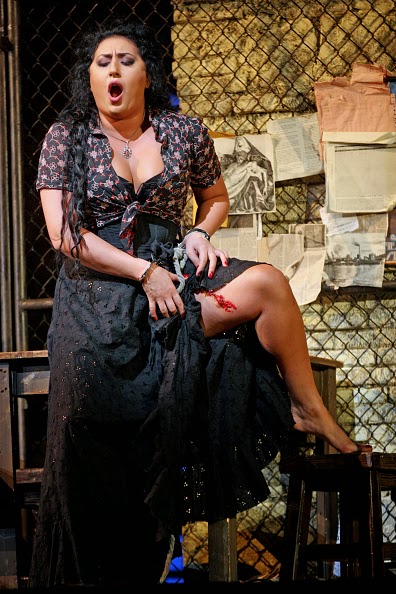
angry Palestinian exiles and in the solo by a Palestinian woman (mezzo-soprano Maya
Lahyani) who seems to represent Omar’s alter ego in the climactic “Desert
Chorus.” The opening and closing numbers of Act One are easily the most
exhilarating moments in the whole piece. Otherwise, this is one of those modern
operas with virtually no arias worth of such name that left me desperately
craving for melody. One would expect that at least the character of Leon
Klinghoffer would express some sort of tragic tension through voice but we were
not so lucky: baritone Alan Opie mostly angrily declaimed his lines in
an operatic voice with no real musicality to it, not even when he was about to
die.
 |
| Photo credit: Dylan Martinez |
 |
| Photo credit: Met |
Nevertheless, the opera concludes on a somber and, for once,
lyrical note and the last word is given to mezzo-soprano Michaela Martens as
the mourning Mrs. Klinghoffer who is distraught but also full of regret because
they didn’t pick her. She hints the fact that she herself is already afflicted
with the fatal illness that would take her life just a short time later, and
her husband, though wheelchair bound, nevertheless always managed against all
odds to keep a great attitude about life. She was the one who should have died
she says. Because this way he would not have died in vain. Because the world did
not take note and his death did not make the world sit up and notice what was
going on since it really elicited so little attention from the international
community. She sings:
“If a hundred / People were murdered / And their blood / Flowed in
the wake / Of this ship like / Oil, only then / Would the world intervene. /
They should have killed me. / I wanted to die.”
Only if more people had been killed would anybody bother to
notice, she sings at the end. Ultimately, this is the gift that the opera gives.
It is a monument to one of the many innocent and virtually forgotten victims of
a conflict that continues to rage on leaving countless unidentified and
publicly unmemorialized victims like Leon Klighoffers in its wake. This is the
story of one whose name will indelibly remain.
- Lui & Lei
 |
| Photo credit: Ken Howard / Met |
 |
| Photo credit: Met |
 |
| Photo credit: Met |